Sold out


A set of three 37 cm Hobby brushes, 15, 25 and 35 mm in diameter, for cleaning the inside of drain pipes and tubes up to 35 mm.
Their flexible heads pass through fittings and short elbows.
 Customer support 7 days a week by email
 Delivery within 2 to 15 business days
A water circuit is not just long flexible pipes. It also includes rigid tubes, strainers, fittings, elbows and pump outlets, where deposits build up just as much and where a single brush never suits every diameter. This Hobby set therefore brings together 3 brushes of 37 cm, of 15, 25 and 35 mm, which cover most aquarium and small pond pipes up to 35 mm internal diameter. That way you always have the right diameter to hand for each part you take apart.
12/16 mm pipe
The 15 mm brush slips in and scrubs the whole wall.
Pipe 16/22 or 19/27 mm
The 25 mm brush cleans the pipes of external filters.
25/34 mm pipe
The 35 mm brush fits into wide outlets.
Rigid tube or fitting
Choose the brush whose diameter is closest by eye.
A brush cleans well when it is slightly wider than the passage it travels through, because its bristles then bend against the wall instead of floating in the centre. This explains the gap between the three diameters in the set: the 15 mm brush suits 12/16 mm pipes, fine suction tubes and the outlets of small pumps; the 25 mm one suits the 16/22 and 19/27 mm pipes of external filters; the largest, at 35 mm, suits drain pipes and the tubes of pond pumps. Their flexible heads, with synthetic bristles, also follow the slight bends of fittings. At 37 cm long, they are meant for short pieces or those open at both ends; for a pipe over a metre long, the Aquael 1.6 m flexible pipe brush takes over.
Replace a pipe that has become opaque and rigid
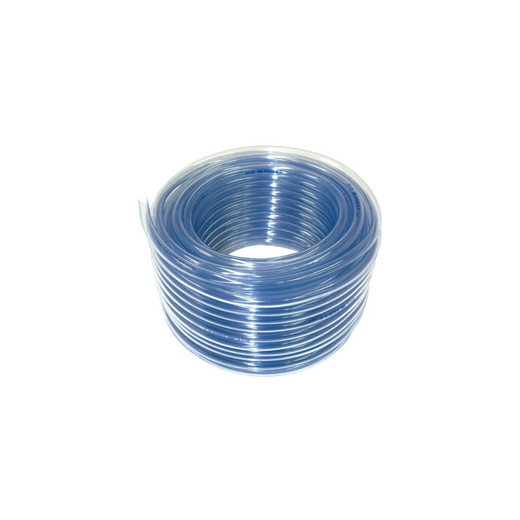
A PVC pipe that has yellowed, hardened or lost its transparency is hard to clean, because deposits cling to its aged wall. The JBL grey flexible pipe, 2.5 m replaces it from 9/12 to 19/27 mm, and its translucent tint lets you see the water flowing while slowing algae on the inner wall. You can therefore see at a glance when a pass with the brush becomes necessary.
Some points in the circuit get clogged faster than others. The intake strainer of a pump catches debris and becomes covered in a mat of algae, the outlet tube of an internal filter builds up a bacterial film, and elbows or T-fittings, where the water slows down, trap sludge. These are also the places where a deposit restricts the flow the most, since the passage is already narrow there. A visual check each time you rinse your filter sponge lets you deal with them before they block, and in a pond, the skimmer tube and the pump outlet to the waterfall deserve the same glance.
Water and vinegar, never household cleaning products
Residues of detergent or household cleaning products remain in the bristles and on the walls of the parts, then pass into the tank water when you reassemble, where they are toxic to fish. So clean your brushes and parts with clear water, and keep diluted white vinegar for limescale. After soaking in vinegar, rinse each part thoroughly before putting it back in place.
Take apart the piece to be cleaned and rinse it once to remove the sludge, then run the brush back and forth, turning it slightly. Rinse again under running water before reassembling. The intake tube and outlet of an internal filter can be cleaned this way in 2 minutes with the 15 mm brush, each time you rinse the sponge. Limescale, common in hard water, sometimes resists brushing: soaking for an hour in diluted white vinegar softens it, and the brush then finishes the job. After use, rinse the brushes and leave them to air dry so that they keep their shape.
An aquaponic system has many short components: bulkhead fittings, elbows, siphon outlets, pump strainers and gutter fittings. The water, rich in organic matter, leaves a deposit there that narrows the passage and can, over time, block the outlet of a grow bed and make it overflow. A 25 or 35 mm brush fits through the most common bulkhead fittings, which saves you from dismantling the bed to clear them. The guide to building your own aquaponic system shows where these parts sit in the circuit, and the article on common mistakes in aquaponics explains what putting off maintenance can cost.
The essentials
To budget for separately
In the box
Dimensions and use: Hobby manufacturer data, taken on 09/10/2026.
Your estimate
It covers preparing your order and then the transit time quoted by the carrier, counted in working days.
It is not a guaranteed delivery date: public holidays, peak periods, customs or a carrier delay can extend it. The exact amount, in your currency, is worked out in the cart once your address is entered.
Delivered to your home by Colissimo or Chronopost, as you prefer at checkout. The exact cost is shown in the basket, according to the total weight of your order.
6 questions
6 key questions

Where to position the filter and pump in a home-built circuit, and what flow rate to aim for based on the fish tank volume.

The start-up mistakes that show on a test reading before they show in the tank, and the order in which to correct them.

What happens during the first weeks of a new grow bed, why the water turns cloudy and why you should not harvest too early.

Cloudy water cannot be read by eye. What measurements reveal about a bacterial film — and what they cannot tell you.
A question about this product or your setup? Our team will answer and advise you.

Interest-free instalment payments
Offered depending on the cart amount, at checkout.

Delivery in 2 to 15 working days
Depending on the products and shipping sites. Estimate by destination in the estimator on this page.

After-sales service 7 days a week by email or chat
Our team answers all your questions.

Shop responsibly
Become part of the change.