



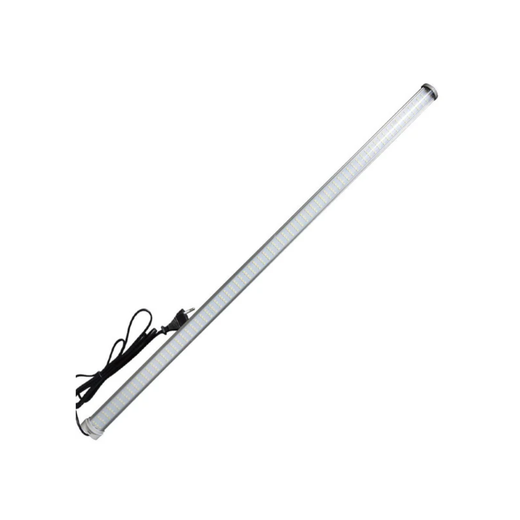


Full-spectrum E27 horticultural LED bulb, 15 or 30 W
Regular price
24,90 €
Regular price
Sale price
24,90 €
Unit price
/
per
This horticultural LED bulb screws into an ordinary E27 socket and turns a desk lamp or a pendant light into a grow light. Its full 4800 K spectrum suits herbs, seedlings and houseplants, and the 30 W version delivers 800 µmol/m²/s at 20 cm.
100 % secure payment
The summary
- What you receive: a Treegers horticultural LED bulb with an E27 cap, in 15 or 30 W.
- Its light: a full spectrum of 4800 K in a 60-degree beam.
- What height: 530 or 800 µmol/m²/s at 20 cm, still 90 or 200 at 50 cm.
- Which power: the GB15W for a pot or a tray, the GB30W for a large plant.
Grow lamp that screws into an E27 socket, for herbs, seedlings and houseplants
The Treegers GB bulb is an LED grow light that screws into an E27 socket, the same as the lamps in your home. It emits a full spectrum with a colour temperature of 4800 K, that is, a neutral white that covers blue as well as red, and it concentrates its light in a 60-degree beam. You place it above a pot of herbs, a houseplant sitting far from a window or a tray of seedlings, with no housing or wiring to arrange, since the lamp you already own serves as the support.
💡 Two power ratings, the same light
The GB15W draws 15 W and produces 1600 lumens in a compact PAR20-type housing, 64 mm in diameter and weighing 150 g. The GB30W doubles the power, with 3200 lumens, in a PAR38 housing 120 mm in diameter whose aluminium fins dissipate heat without a fan. Both share the same 4800 K spectrum, a colour rendering index above 90 and an efficacy of 2.2 µmol/J, which means that every watt consumed delivers the same amount of useful light to the plants, whichever version you choose.
GB15W
It lights a pot of herbs, a houseplant or a small tray of seedlings on a windowsill.
GB30W
Its dual airflow means it can be installed higher up, above a bulkier plant or a group of pots.
📐 Light intensity by height
The light intensity received by a plant is measured in PPFD, photosynthetic photon flux density, expressed in micromoles per square metre per second. It drops quickly as the lamp moves away, which makes the mounting height as important as the power. Under the GB15W, the foliage receives 530 µmol/m²/s at 20 cm, 250 at 30 cm, 90 at 50 cm and 60 at 60 cm. The GB30W delivers 800 µmol/m²/s at 20 cm, 450 at 30 cm, 200 at 50 cm and 100 at 60 cm, so it can light a plant that has grown from higher up.
A bulb and a timer for a seedling station
Screwed into an adjustable lamp and connected to a daily timer, the bulb provides the same lighting period every day above your peat germination pods. Young plants stay sturdy instead of stretching towards the window, and you can start your basil or lettuce seedlings as early as the end of winter.
A lamp holder strong enough to carry 450 g
The GB30W weighs 450 g, far more than an ordinary bulb. Check that your lamp or pendant fitting can support this weight and that its E27 socket is in good condition. The IP44 rating protects the bulb from water splashes, but not from direct watering or immersion, so always switch off the power before handling it.
🐟 A bulb for indoor aquaponics
In aquaponics, as in indoor hydroponics, a single bulb is often enough to light a small system set on a piece of furniture, for example a tub of basil using the Kratky method or a few baskets of salad leaves above a living-room aquarium. Herbs such as basil, mint or chives grow well under a full spectrum, and the article on herbs in aquaponics sets out their needs in detail. Keep the bulb above the foliage and away from the water surface, so that the light benefits the plants rather than the algae in the tank, and so that the humidity rising from the warm water does not reach the bulb holder.
Before going into an aquaponic system, a lettuce or a basil plant goes through a nursery stage, and this is often where the bulb is most useful. The seeds germinate in an inert grow medium such as rock wool or coconut fibre, under light kept on for 14 to 16 hours a day, and the seedlings move to the grow beds at least 2 weeks after their first true leaves appear. A GB15W placed 20 or 30 cm above a tray prevents these young plants from becoming leggy, stretching and flopping over when the light comes from a side window. They then reach the system with a short, firm stem, better equipped to withstand the flow of water in a bed or channel. The guide to succeeding with spring seedlings in aquaponics describes the rest of the calendar.
🎯 The illuminated area
The 60-degree beam sets the size of the illuminated area. At 30 cm from the foliage, it covers a disc about 35 cm in diameter, and at 50 cm a disc about 58 cm across. Raising the bulb therefore widens the area covered, while the intensity drops at the same time, as the measurements at different heights show. For a single pot, a low position concentrates the light where it is needed; for a 50 cm long seed tray, the GB30W placed at 50 cm covers the whole tray with 200 µmol/m²/s at the centre of the beam. If your lamp lights at an angle, turn the pots a quarter turn each week, and add a second bulb rather than raising the first too high as the crop spreads.
🔁 Lighting duration and power consumption
An indoor plant generally receives between 12 and 16 hours of light a day, depending on the species and its growth phase. At this rate, the GB15W uses 0.18 kWh for 12 hours of lighting and the GB30W 0.36 kWh, which remains modest for a lamp switched on every day. The LEDs are rated for 50,000 hours of operation, which is more than 11 years at 12 hours a day, and their passive cooling makes no noise, which matters in a living room.
To compare two settings, growers use the daily light integral, or DLI, which accumulates the intensity received over the whole lighting period. It is calculated by multiplying the PPFD by the number of hours and by 3,600 seconds, then dividing the total by one million. Under the GB15W placed at 30 cm, 250 µmol/m²/s for 14 hours thus gives 12.6 mol/m² per day, and the GB30W at the same height delivers 22.7. Lengthening the lighting period therefore partly makes up for a lamp placed higher, which gives you latitude to adjust the height as your plants grow, without changing the bulb.
🔎 Reading the figures on the box
The box states 1,600 or 3,200 lumens, a measurement made for the human eye and not for photosynthesis: two lamps with the same output in lumens can deliver very different amounts of light that is useful to plants. The figures that matter are the efficacy, 2.2 micromoles of photons per joule, and above all the irradiance measured beneath the bulb, in µmol/m²/s, which the manufacturer gives at 20, 30, 50 and 60 cm. Compare it with the needs of the crop. The University of Missouri puts lettuce at between 250 and 350 µmol/m²/s: the GB15W reaches this at 30 cm, the GB30W between 30 and 50 cm. A houseplant far from a window makes do with less, and a PAR quantum meter held at leaf height tells you what it actually receives. The guide to LED lighting for indoor growing explains in detail how to go from this measurement to the daily light integral.
👁️ Glare and wiring
Screwed into a desk lamp or a reading light, the bulb is often at eye level, and its 60-degree beam is intense at close range. ANSES confirms the toxicity of blue light for the retina and describes short-term effects after acute exposure: point the lamp downwards, do not look at the lens while it is lit, and prefer an open lampshade that hides the bulb without enclosing it. On the electrical side, the lamp plugs into a socket protected by a 30 mA residual current device, and a 16 A weekly timer easily handles its 15 or 30 W. Its IP44 rating protects it from water splashes coming from all directions, but not from direct watering: water with the lamp switched off, and keep the lampholder away from the steam of hot water.
Technical specifications
Lighting
- Spectrum
- Full spectrum, 4800 KNeutral white covering the blue and the red
- Luminous flux
- 1600 or 3200 lm1600 lm for the GB15W, 3200 lm for the GB30W
- Efficiency
- 2.2 µmol/J
- Beam
- 60 degreesColour rendering index above 90
The bulb
- Base
- E27The one used by household lamps and pendant lights
- Format and size
- PAR20, 64 x 94 mm120 x 135 mm PAR38 for the GB30W
- Weight
- 150 or 450 gThe GB30W needs a sturdy lamp holder
- Voltage
- 100 to 240 VPassive cooling, no fan
Usage
- Intensity at 20 cm
- 530 or 800 µmol/m²/sGB15W then GB30W
- Intensity at 50 cm
- 90 or 200 µmol/m²/sGB15W then GB30W
- Protection
- IP44Protected against splashes, not against direct watering
- Lifespan
- 50,000 h
- Target light
- 250 to 350 µmol/m²/sFor a lettuce; less for a foliage plant
- Electrical protection
- 30 mA residual current deviceWatering with the lamp off
To allow for in addition
- Support
- Lamp or pendant with an E27 socketPreferably adjustable, to set the height
- Timer
- Daily timerTo keep the same lighting duration every day
8 further specifications are available in the detailed view.
In the box
- 1 Treegers GB horticultural LED bulb, 15 or 30 W
Manufacturer's values (Treegers GB15W and GB30W datasheets), including intensities measured at 20, 30, 50 and 60 cm.
Manufacturer and product safety
- Website
- treegers.com
Information provided under Regulation (EU) 2023/988 on general product safety.
GB15W or GB30W?
The same 4800 K full spectrum, in a compact housing or in a housing twice as powerful.
15 or 30 W?
Answer three questions about your plant and your lamp, and the table highlights the right match.
| Luminous flux (lm) | Intensity at 30 cm (µmol/m²/s) | Weight (g) | Price | |
|---|---|---|---|---|
| Recommended 15 W, GB15WYour choice | 1600 lm | 250 µmol/m²/s | 150 g | 24,90 € |
| 30 W, GB30WYour choice | 3200 lm | 450 µmol/m²/s | 450 g | 47,90 € |
15 W, GB15WRecommended
Luminous flux (lm)1600 lm
Intensity at 30 cm (µmol/m²/s)250 µmol/m²/s
Weight (g)150 g
30 W, GB30W
Luminous flux (lm)3200 lm
Intensity at 30 cm (µmol/m²/s)450 µmol/m²/s
Weight (g)450 g
Manufacturer's values (Treegers GB15W and GB30W data sheets).
Buying guide
Three questions to help you choose your bulb
Estimate your
delivery time
Your estimate
Delivery
Estimated time
It covers preparing your order and then the transit time quoted by the carrier, counted in working days.
It is not a guaranteed delivery date: public holidays, peak periods, customs or a carrier delay can extend it. The exact amount, in your currency, is worked out in the cart once your address is entered.
The bulb is sent in its original box, as a small parcel of 0.2 kg for the GB15W and 0.7 kg for the GB30W. The exact shipping cost is shown in your basket.
Frequently asked questions
8 questions
6 key questions, 8 in the detailed view
You may also like


Related articles

Lighting
LED lighting for indoor growing
PPFD, DLI and spectrum are explained there, enough to choose the height of the bulb above the plant.
Read the article

Crops
Herbs in aquaponics
A pot of basil or mint under an E27 bulb is enough to start the herbs described in the article.
Read the article

Hydroponics
The Kratky method: passive hydroponics without a pump
A Kratky jar of basil is grown without a pump under a single horticultural bulb.
Read the article

Seedling
Setting up an indoor seedling area
The article shows how a lamp with an E27 socket becomes a small seedling station.
Read the article

Seedling
Germination failure: causes and solutions
Seedlings that lean towards the window find their causes here, and the bulb gives them back a vertical light.
Read the article

Hydroponics
Getting started with indoor hydroponics
This starter guide shows when a horticultural bulb is enough for a first indoor crop.
Read the article

Seasons
What to sow in autumn in aquaponics
The autumn calendar lists the salads to start under an E27 bulb as the days draw in.
Read the article
Let us talk about your project
A question about this product or your setup? Our team will answer and advise you.

Interest-free instalment payments
Offered depending on the cart amount, at checkout.

Delivery in 2 to 15 working days
Depending on the products and shipping sites. Estimate by destination in the estimator on this page.

After-sales service 7 days a week by email or chat
Our team answers all your questions.

Shop responsibly
Become part of the change.
