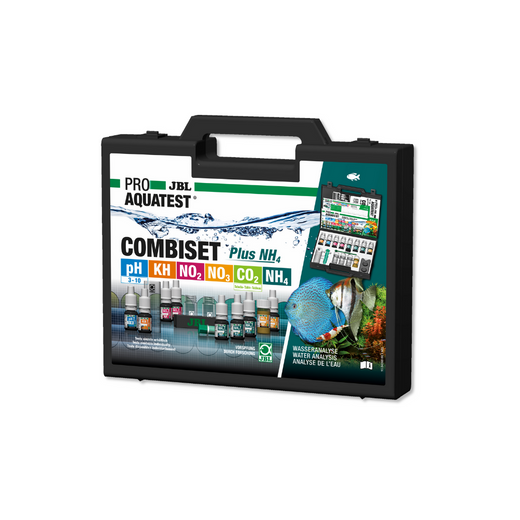


Nitrite NO2 water test in drops
Regular price
13,90 €
Regular price
Sale price
13,90 €
Unit price
/
per
4,63 € × 3 with no fees
Klarna.
Nitrite is, along with ammonia, one of the two toxic compounds in a new tank. It appears after the ammonium, when the first family of bacteria is already active and the second is not yet established, and it blocks the transport of oxygen in your fish's blood.
This test measures it from 0.025 to 1 mg/L after 5 minutes, across nine colour fields, in freshwater as in seawater.
 Customer support 7 days a week by email
 Delivery within 2 to 15 business days
100 % secure payment
The summary
- What you receive: 2 reagent bottles, 2 glass test tubes, a syringe, a grey comparator block and a colour chart.
- What nitrite does: it oxidises haemoglobin and blocks oxygen transport. A fish can suffocate in perfectly oxygenated water.
- The threshold that matters: 0.5 to 1 mg/L can already be lethal depending on the species, and fry are more sensitive to it than adults.
- How long it takes: 7 minutes in total, including 5 minutes waiting for the colour to develop.
- How to choose: this is the bottle you empty first in a test kit, because it's the one you reach for most often.
- What we send you: a parcel weighing 0.15 kg, reagents in their original packaging.
Nitrite drop test, from 0.025 to 1 mg/L, read in 5 minutes, with a target of zero
Nitrite is invisible and odourless. It always appears at the same point: a few days after ammonium, once the bacteria that convert ammonium into nitrite have established themselves but before those that convert nitrite into nitrate are sufficiently numerous. This is the nitrite spike, and it accounts for a large proportion of the losses seen during the first 3 weeks of a new tank.
🩸 Nitrite and haemoglobin
Nitrite uses the chloride ion transporter at the gill surface, concentrates in the plasma to up to 60 times the level in the water, and then oxidises the iron in haemoglobin. This converts it to methaemoglobin, which can no longer bind oxygen, and the blood takes on a brown tint. Your fish may therefore gasp at the surface and suffocate in oxygen-saturated water, because the oxygen present in the water is no longer carried to their tissues.
Because nitrite enters through the chloride transporter, dissolved chloride competes directly with it. Adding salt is therefore the only measure that protects your fish without changing anything about the nitrite content of the water. Relative to the value read by this test, expressed as NO2, the benchmark used in fish farming is around 2.5 mg/L of chloride per mg/L of nitrite for cyprinids, and around 5 for salmonids, which are more sensitive. Use a non-iodised salt with no anti-caking agent, dissolved separately, and never in an invertebrate tank or in a circuit feeding growing beds.
Sensitivity varies enormously depending on the species
Depending on the species, concentrations between 0.5 and 1 mg/L can already be lethal, and marine fish as well as fry are more sensitive than adults. Trout, salmon, and catfish are the most vulnerable; carp, tench, and eels are far more tolerant. A level that a koi carp can survive may therefore kill a trout in the same pond.
📈 Where your cycling stands
Nitrite rising, ammonium falling
This is the normal sequence of cycling. Measure every day and do not introduce fish.
Both tops together
Cycling has not started or has just been interrupted: filter rinsed under the tap, pump switched off.
Nitrite returning in an established tank
This situation is never normal; the usual causes are a sudden addition to the stock, overfeeding, a dead fish, or a blocked filter.
In aquaponics
A value readable on an established system indicates that your biofilter is undersized for the fish load.
Read nitrite alongside the ammonium result from the same day
If you are starting a tank or a system, use the ammonium test alongside this one. Nitrite alone does not tell you where your cycling stands, whereas both values read together do: ammonium falling while nitrite rises shows that the first bacterial colony is established. You will know whether to wait before adding fish, rather than finding out from their behaviour.
The only acceptable value is zero. Unlike nitrate, there is no tolerable range: any readable value indicates that nitrification is not converting all the nitrite produced, and the first course of action is a water change of around half the volume, while the bacteria recolonise the filter. The actions that trigger a spike, from rinsing a filter under the tap to introducing fish all at once, are covered in our article on common mistakes.
❄️ Nitrite when the water cools down
In autumn, the activity of nitrifying bacteria slows with the water temperature, while the fish are still receiving their full ration. A feed too rich in protein then produces more ammonia than the biofilter can convert, and nitrite levels rise dangerously in a pond that had remained stable all summer. Switch to a winter food, higher in lipids and lower in protein, as soon as the water begins to cool, as explained in the article on feeding fish in winter. An aquaponic system goes through the same transition, and one reading per week is sufficient to monitor it.
The test also works on cold water, but the colour develops more slowly, sometimes with a significant delay. Store the reagents at room temperature, between 20 and 25 °C, and leave your sample to stand for approximately 2 hours in a heated room before testing. If you obtain two conflicting readings taken at different temperatures, take the higher value as your reference.
Technical specifications
The essentials
- Parameter measured
- Nitrite, expressed as NO2The intermediate between ammonium and nitrate in the nitrogen cycle
- Measurement range
- 0.025 to 1 mg/LThe target is zero: unlike nitrate, no readable value is comfortable
- The colour chart fields
- 0,01 · 0,025 · 0,05 · 0,1 · 0,2 · 0,4 · 0,6 · 0,8 · 1,0Nine values, from yellow to pink. The first field, 0.01, falls below the measurement range
- Danger threshold
- 0.5 to 1 mg/L depending on the speciesMarine fish and fry are more sensitive than adults
- Tests per kit
- Approximately 50It is the first bottle you empty in a test kit, because it is the routine cycling test.
- Manufacturer's reference
- JBL 2412300, PROAQUATEST rangeCode EAN 4014162241238
The procedure
- Water volume
- 2 times 5 mlOne treated sample and one untreated blank, side by side in the comparator block
- The steps
- Rinse, fill, add reagent 1, add reagent 2, wait, readAdd 5 drops of each reagent, swirling after each addition
- Waiting time
- 5 minutesFull colour development time
- Total duration
- Approximately 7 minutesHandling included
- Reading
- In the comparison blockThe grey block compensates for the natural colour of the water, including peat
- Environments covered
- Freshwater and saltwaterOne measurement per day for 3 weeks on a new freshwater tank, one per week in saltwater
Security and parcels
- Ranking
- DangerBoth bottles are classified, and reagent 2 is flammable
- Main risks
- Burns, eye injuriesH314 and H318 hazard statements for reagent 1, H226 and H319 for reagent 2
- Precautions
- Sink, well-ventilated room, out of reachChild-safety caps on both bottles
- Parcel weight
- 0.15 kgPackaging included
To budget for separately
- The matching test
- An ammonium testThe two readings taken together show how far along your cycling is
- Reagent refill
- Reagents only, ref. 2412400The glassware, comparator block and colour chart can be kept
10 further specifications are available in the detailed view.
In the box
- 2 reagent bottles with child-resistant caps
- 2 glass test tubes with screw caps
- 1 graduated sampling syringe
- 1 grey laboratory comparator block
- 1 colour chart with 9 colour fields
- 1 multilingual instruction leaflet, French included
Reference, EAN code, kit composition, number of tests, protocol, mortality threshold and hazard statements taken from the manufacturer's product sheet and instructions on 05/09/2026. The range and nine fields are read from the colour chart supplied. The chloride-to-nitrite ratios, converted to NO2 from the EIFAC recommendation expressed as nitrous nitrogen, and the plasma concentration factor are taken from aquaculture veterinary literature.
Nitrite alone, or the entire nitrogen sequence?
Nitrite comes after ammonium and converts into nitrate. The question is whether you want to see one stage of the chain or the whole sequence.
The nitrite peak occurs in the middle of the cycle
It rises as ammonium falls, and it can be read on its own or as part of the full NH4, NO2, NO3 sequence. What you need depends on where you are in the process.
| Parameters covered (parameters) | Drop tests included (tests) | Nitrite NO2, the most toxic stage | Ammonium NH4, the preceding stage | Nitrate NO3, the next stage | pH and KH, which govern bacterial activity | Iron, phosphates, copper, silicates, oxygen | Reagent bottles (bottles) | Glass test tubes | Laboratory comparator block | Thermometer | Reagent refill sold separately | Price | |
|---|---|---|---|---|---|---|---|---|---|---|---|---|---|
| Recommended Nitrite test onlyYour choice | 1 parameters | 1 tests | Yes | No | No | No | No | 2 bottles | 2 | Yes | No | Yes | 13,90 € |
| 6-in-1 Aquarium Water Testing KitYour choice | 6 parameters | 5 tests | Yes | Yes | Yes | Yes | No | 9 bottles | 3 | Yes | No | Yes | 50,90 € |
| 14-in-1 water analysis kit for aquariumYour choice | 14 parameters | 13 tests | Yes | Yes | Yes | Yes | Yes | 23 bottles | 12 | Yes | Yes | Yes | 119,90 € |
Nitrite test onlyRecommended
The nitrogen cycle
Parameters covered (parameters)1 parameters
Drop tests included (tests)1 tests
Nitrite NO2, the most toxic stageYes
Ammonium NH4, the preceding stageNo
Nitrate NO3, the next stageNo
pH and KH, which govern bacterial activityNo
Iron, phosphates, copper, silicates, oxygenNo
Equipment supplied
Reagent bottles (bottles)2 bottles
Glass test tubes2
Laboratory comparator blockYes
ThermometerNo
Budget
Reagent refill sold separatelyYes
6-in-1 Aquarium Water Testing Kit
The nitrogen cycle
Parameters covered (parameters)6 parameters
Drop tests included (tests)5 tests
Nitrite NO2, the most toxic stageYes
Ammonium NH4, the preceding stageYes
Nitrate NO3, the next stageYes
pH and KH, which govern bacterial activityYes
Iron, phosphates, copper, silicates, oxygenNo
Equipment supplied
Reagent bottles (bottles)9 bottles
Glass test tubes3
Laboratory comparator blockYes
ThermometerNo
Budget
Reagent refill sold separatelyYes
14-in-1 water analysis kit for aquarium
The nitrogen cycle
Parameters covered (parameters)14 parameters
Drop tests included (tests)13 tests
Nitrite NO2, the most toxic stageYes
Ammonium NH4, the preceding stageYes
Nitrate NO3, the next stageYes
pH and KH, which govern bacterial activityYes
Iron, phosphates, copper, silicates, oxygenYes
Equipment supplied
Reagent bottles (bottles)23 bottles
Glass test tubes12
Laboratory comparator blockYes
ThermometerYes
Budget
Reagent refill sold separatelyYes
Parameters covered, equipment supplied and kit contents noted from the three product pages on 05/09/2026.
Help choosing
Monitor nitrite throughout the cycling process
Documents & manuals
Official manufacturer's instructions, in French
Six-step protocol, number of drops, colour development time, mortality threshold by species, and what to do if a reading is high.
Document not showing? Some publishers block display inside a frame, so open it in a tab.
Estimate your
delivery time
Your estimate
Delivery
Estimated time
It covers preparing your order and then the transit time quoted by the carrier, counted in working days.
It is not a guaranteed delivery date: public holidays, peak periods, customs or a carrier delay can extend it. The exact amount, in your currency, is worked out in the cart once your address is entered.
Parcel weight 0.12 kg, dispatched to a collection point or by Colissimo to your home address — your choice at checkout. The reagents travel upright in their original box. The exact cost is shown in the basket.
Frequently asked questions
6 questions
6 key questions
You may also like


Related articles

Guide
The nitrogen cycle in aquaponics
Why nitrite appears after ammonium, and why it disappears once the second family of bacteria becomes established.
Read the article

Species
Salmoponics: aquaponics in cold water
Trout is the species most sensitive to nitrite. Keeping salmonids requires far closer monitoring.
Read the article

Species
Raising tilapia in aquaponics
At the other end of the sensitivity scale, tilapia tolerates conditions that would kill a trout, without being invulnerable.
Read the article

Getting started
Goldfish in aquaponics
The first tank is where the nitrite spike does the most damage. How to get through the first three weeks.
Read the article

Guide
Common mistakes in aquaponics
Rinsing a filter under tap water, adding the population all at once: the actions that cause nitrite to rise again.
Read the article

Guide
Which fish to choose for aquaponics?
Sensitivity to nitrite varies enormously between species, and the fish load determines how much the biofilter needs to handle.
Read the article
Let us talk about your project
A question about this product or your setup? Our team will answer and advise you.

Interest-free instalment payments
Offered depending on the cart amount, at checkout.

Delivery in 2 to 15 working days
Depending on the products and shipping sites. Estimate by destination in the estimator on this page.

After-sales service 7 days a week by email or chat
Our team answers all your questions.

Shop responsibly
Become part of the change.
