
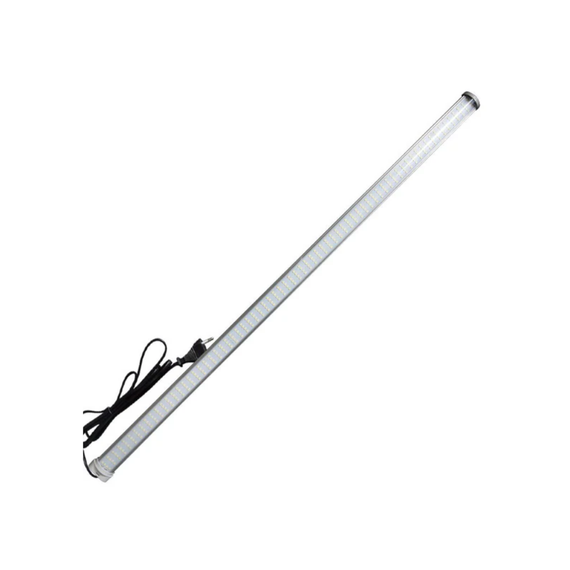

Advanced Star 42 W flowering LED bar, 95 cm
Regular price
89,90 €
Regular price
Sale price
89,90 €
Unit price
/
per
29,96 € × 3 with no fees
Klarna.
This 95 cm LED bar emits a 3000 K warm white light, enriched with red at 640 to 660 nm, for flowering and fruit set. Its housing is made of aluminium, and the hanging brackets are supplied.
It covers up to one square metre depending on the mounting height, and several bars can be fitted in a row to cover an entire table.
 Customer support 7 days a week by email
 Delivery within 2 to 15 business days
100 % secure payment
The summary
- Its spectrum: warm white 3000 K enriched with red, for flowering.
- What it covers: up to one square metre, depending on the height at which you hang it.
- Which crops it suits: tomatoes, peppers, strawberries and every plant harvested for its fruit.
- When to switch it on: when the first buds appear, not before.
- How much effort: a few minutes a week, a monthly dusting, a reset each cycle.
- How it arrives: in a single long, light parcel, hanging fittings included.
Warm white 3000 K light enriched with red, for flowering and fruiting
The Advanced Star 42 W, 95 cm flowering LED bar from Advanced Star supports the flowering and fruiting of tomatoes, peppers and strawberries. Its warm white light of 3000 K, enriched with red from 640 to 660 nm, suits the flowering phase. It covers up to 1 m² depending on the hanging height.
This 95 cm bar gives off a warm white light of 3000 K, boosted in red from 640 to 660 nm, the region of the spectrum that supports flowering and fruit swelling. It draws 42 W, its housing is aluminium and the hanging kit is supplied.
🌸 A spectrum for flowering
Colour temperature, expressed in kelvins, tells you which colour a white light leans towards. At 6500 K, that of grow light bars, the white is cool and rich in blue, which produces sturdy plants with compact foliage. At 3000 K, the white becomes warm and its share of red increases markedly. Deep red is strongly absorbed by chlorophyll, and it also acts on phytochrome, the pigment through which the plant perceives day length. This is why growers reserve this spectrum for the stage when your plants flower and set fruit, after a foliage stage grown under a cooler white.
An IP20 bar to be kept clear of splashes
Its ingress protection rating is IP20: the bar is protected against finger contact, but not against water. Hang it above the crops, never above an open tank where water can splash, and switch off the power before any work on the watering system or on the bar. Form a low loop in the cable, below the level of the socket, so that water running down the cable drips off before it reaches the plug. Finally, connect the bar to a circuit protected by a 30 mA residual current device.
🍅 Fruit under cover
The crops that benefit are those grown for their fruit: tomatoes, peppers, chillies, strawberries, as well as ornamental flowers. Indoors or in a greenhouse short of light, these species grow well in leaf, then struggle at the flowering stage, for lack of enough light to bring the fruit through to maturity. In a closed space, with no wind or insects, pollination is done by hand, with a small brush or by gently vibrating the stems.
Potassium at the point of switchover
The light bar provides the light the plant needs to flower; a potassium supplement then supports fruit set, at the point where the plant's potassium needs increase while its nitrogen needs decrease. It thus accompanies the same change of phase as the lamp, as soon as the first buds appear.
In an aquaponic system, this change of phase also shows in the water. The nitrogen supplied by the fish covers the foliage phase well, but the demand for potassium rises when the fruit forms, and a potassium deficiency shows first on the oldest leaves, whose edges turn yellow and then brown, well before it can be seen on the fruit. So keep an eye on your plants as soon as you switch this light bar on, rather than waiting until harvest.
📐 One square metre per bar
One bar covers up to one square metre, and that "up to" depends entirely on the height at which you hang it. Kept well away from the plants, it spreads its light over a wider area but gives each leaf less; brought closer, it concentrates it. During fruiting, it is better to aim for intensity over a clearly defined area than to spread the light over the whole room, especially as the bar measures 95 cm long by 5 cm wide.
Measure your table before ordering: it is this measurement, not the number of plants, that tells you how many bars you need. A tomato plant trained on a single stem takes up far less floor area than one left to grow freely, so the same bar will cover more plants if you prune. For a table of 1.20 m by 2 m, or 2.4 m², you should therefore plan on three parallel bars.
🔗 Fitting several bars in a row
Several bars can be hung side by side to cover a whole table, and a growth bar can sit alongside this one on a table where different stages follow one another. Two 42 W bars draw 84 W from the mains, or about 1 kWh a day for 12 hours of lighting, which lets you estimate consumption before expanding. A few mounting rules help avoid uneven growth from one end of the row to the other.
Space them out evenly
Two parallel bars light better than a single one hung very high, over the same surface.
Keep a single timer
Light bars that switch on at different times create visible differences along the row.
Add up the total power
Add up the bars before plugging everything into a single extension lead.
Hang independently
Hang each bar from its own anchor point, so that you can adjust one without touching the others.
🗓️ When to switch to the flowering spectrum
The change of spectrum is made when the plant is sturdy enough to carry fruit, that is, when the first buds appear, and not before. A plant switched too early to this spectrum flowers on a structure that is too light and yields little. The lighting duration, for its part, stays the same from one day to the next: set it on a timer socket, because it is the regularity of the day and night cycle that matters. On a table where seedlings follow harvests, a growth bar and this flowering bar therefore share the season, each on the stage that suits it according to what you are growing.
Technical specifications
The essentials
- Spectrum
- Warm white 3000 KEnriched in red from 640 to 660 nm, for flowering and fruit set.
- Power consumption
- 42 WThe power actually drawn from the mains, the figure that shows up on the meter.
- Dimensions
- 95 x 5 x 3 cmThe bars hang side by side to cover a wider table.
- Area covered
- Up to 1 m²Depending on the mounting height: higher covers a wider area, but gives each leaf less.
- Casing and protection
- Aluminium, IP20The aluminium draws heat away from the diodes; IP20 means no protection against water.
- Service life
- 30,000 to 50,000 hoursThe diodes lose intensity gradually rather than going out all at once.
To budget for separately
- Adjustable suspension
- A set of self-locking pulleysThe canopy quickly gains height during fruiting, and the height of the bar often needs adjusting.
- Timer
- A timer socketThe same times every day: it is the regularity of the cycle that matters for flowering.
In the box
- 1 flowering LED bar of 95 cm, aluminium housing.
- 1 set of hangers.
Spectrum, power, dimensions, protection rating, area covered and lifespan: Advanced Star technical data sheets recorded on 11/10/2026.
Estimate your
delivery time
Your estimate
Delivery
Estimated time
It covers preparing your order and then the transit time quoted by the carrier, counted in working days.
It is not a guaranteed delivery date: public holidays, peak periods, customs or a carrier delay can extend it. The exact amount, in your currency, is worked out in the cart once your address is entered.
Long, light parcel, the length of the bar: shipping is charged on bulk rather than weight. If you order several bars, they travel together. The exact delivery costs are shown in the basket once your address has been entered.
Frequently asked questions
10 questions
6 key questions, 10 in the detailed view
Upkeep and the real cost
During fruiting, the canopy gains height quickly and the lamp needs adjusting more often than during the foliage phase.
Allow a few minutes a week, plus a complete reset at the start of each new cycle.
The time it takes
5 ha year, that is 6 min a week
- Every week3 min each time 2.6 ha year
- Every month8 min each time 1.6 ha year
- Every season15 min each time 1.0 ha year
Tap or hover over a frequency to see the tasks it covers.
You may also like


Related articles

Crops
Growing tomatoes in aquaponics
The crop that needs the most light when fruit is setting.
Read the article

Technique
Pollinating your plants indoors
What light cannot do: carry pollen from one flower to another.
Read the article

Crops
Growing peppers in aquaponics
A species that is slow to set fruit and benefits greatly from extra light.
Read the article

Crops
Growing strawberries in aquaponics: the complete guide
Fruit all year round under cover, provided you light the flowering stage.
Read the article

Diagnosis
Plant deficiencies in aquaponics
What a plant needs when it moves into the fruiting stage.
Read the article

Seasons
What to grow in hydroponics, season by season
When natural light is no longer enough to bring a fruit to maturity.
Read the article
Let us talk about your project
A question about this product or your setup? Our team will answer and advise you.

Interest-free instalment payments
Offered depending on the cart amount, at checkout.

Delivery in 2 to 15 working days
Depending on the products and shipping sites. Estimate by destination in the estimator on this page.

After-sales service 7 days a week by email or chat
Our team answers all your questions.

Shop responsibly
Become part of the change.
