Iron Deficiency in Aquaponics

Written by Tristan Ulrich · February 1, 2026
carence en aquaponie

Iron deficiencies are among the most common problems encountered by aquaponic growers. Yellow leaves, slowed growth, and plants that stagnate despite clear water and a functioning nitrogen cycle are often the first visible signs of a lack of absorbable iron.

Without appropriate correction, this deficiency severely limits photosynthesis and prevents plants from developing properly, even when nitrates are sufficient.

The most frequent imbalance in aquaponics

In aquaponics, it's common to observe plants that yellow, stagnate, or seem weak even when the system appears stable. The water is clear, the fish are healthy, nitrates are present… and yet, plant production doesn't take off. In the vast majority of cases, this phenomenon is linked to an iron deficiency, one of the most frequent imbalances in aquaponics.

Iron is a paradoxical element : essential for plant growth, yet difficult to maintain in an assimilable form in an aquaponic system. Its availability depends closely on pH, water chemistry, and the form in which it is supplied. Without a precise understanding of these mechanisms, adjustments are often ineffective, temporary, or incorrectly dosed.

The role of iron in plant growth

The role of iron in plant growth

Iron is an essential micronutrient for plant function. It plays a direct role in photosynthesis, chlorophyll production, and several enzymatic reactions vital for growth. Without readily available iron, a plant is unable to efficiently convert light into energy, even if all other nutrients are present.

In aquaponics, this role is even more critical because plant growth relies on a precise balance between nutrients from the fish and the plants' ability to absorb them. An iron deficiency acts as a biological lock : the system can produce sufficient nitrates, but the plant remains stunted.

Iron is also a non-mobile nutrient in the plant. This means that once a leaf is deficient, the plant cannot redistribute iron from older leaves. This is why symptoms first appear on young shoots.

Identifying an iron deficiency in aquaponics Iron Test (FE)

Identifying iron deficiency in aquaponics

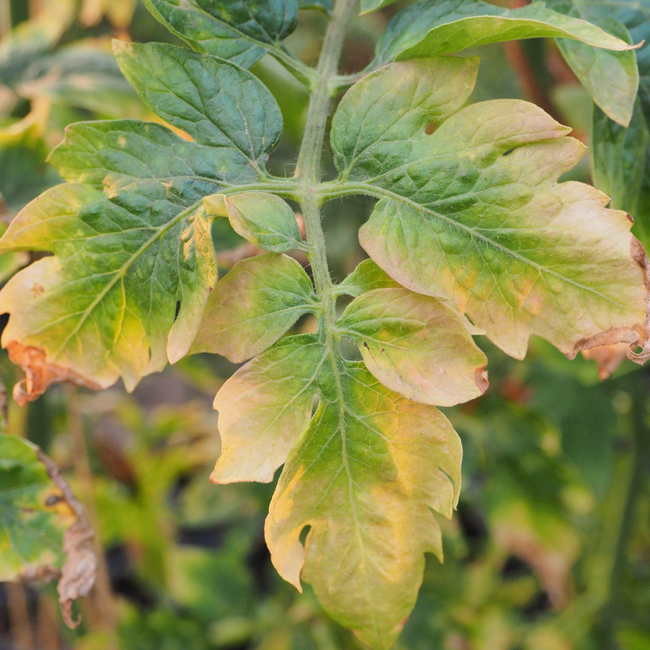
The most common sign of an iron deficiency is interveinal chlorosis on young leaves: the tissue turns pale yellow while the veins remain green. Older leaves, by contrast, remain relatively healthy at first. This point is essential for distinguishing an iron deficiency from a nitrogen deficiency, which affects older leaves first.

As the deficiency takes hold, growth slows noticeably. New leaves are smaller, more fragile, and some plants stop developing altogether. Fast-growing crops such as lettuces, herbs, tomatoes, and cucumbers are often the first to show visible symptoms.

When these signs appear while nitrates are present and the system is otherwise stable, an iron deficiency is almost always the primary cause.

Why your aquaponic systems are short of iron

Why are your aquaponic systems lacking iron ?

Contrary to what one might think, the iron naturally provided by fish is largely insufficient to meet the needs of plants in aquaponics.

The main problem stems from the pH. At a pH close to or above 7, free iron precipitates and becomes unavailable to the roots. However, many aquaponic systems naturally operate within a pH range of 6.8 to 7.5, particularly for the well-being of the fish and bacterial stability.

The result : even if iron is present, it is not usable by plants. This is why iron deficiencies appear in both young systems and mature, well-balanced installations.

Chelated iron is essential in aquaponics Chelated iron (iron chelate) DTPA 11%

Chelated iron is essential in aquaponics

To remain available in the water and absorbable by plants, iron must be chelated. Chelation involves surrounding the iron ion with a protective molecule that prevents it from precipitating, even when the pH is not optimal.

Unchelated iron is unusable in aquaponics: it precipitates rapidly and settles throughout the system without ever being absorbed. Conversely, chelated iron suited to aquaponics remains soluble, disperses correctly, and is progressively absorbed by the roots. This is why chelated iron is considered a basic input in aquaponics, on a par with pH management and filtration. Without it, achieving stable, lasting plant growth is very difficult.

At Univers Aquaponie, we stock a chelated iron formulated for aquaponics, designed to remain effective across the pH ranges typical of domestic systems.

Which chelated iron to choose for your aquaponic system Chelated iron (iron chelate) EDDHA 6%

Which chelated iron should I choose for my aquaponics system ?

Not all chelated irons are equal. Their effectiveness depends on the type of chelating agent used and the pH range within which they remain stable. A good chelated iron for aquaponics is:

  1. Stable in water
  2. Readily absorbable
  3. Safe for fish and bacteria
  4. Easy to dose accurately.

In aquaponics, it is essential to choose a chelated iron compatible with a pH of between 6.5 and 7.5, which covers the majority of balanced systems. A poorly matched product can lose its effectiveness very quickly or require excessive dosing.

Correcting an iron deficiency without upsetting the balance

Correcting an iron deficiency without disrupting the balance

Correcting an iron deficiency should always be done gradually. The goal is not to force growth, but to restore sufficient availability so that plants can function normally.

Chelated iron is added directly to the system water, strictly following the recommended dosages. The first signs of improvement usually appear within a few days, but attention should be focused primarily on new leaves.

Leaves that have already turned yellow do not always regain their green color. New growth, however, should recover a strong coloration, thicker texture, and more consistent growth. To support this phase, using reliable pH tests helps ensure that the added iron remains readily available over time.

Chelated iron and pH: a balance to watch Hydrogen Potential Test

Chelated iron and pH : a balance to monitor

Even with an excellent chelated iron supplement, poor pH management limits the overall effectiveness of the system. Iron is therefore an excellent indirect indicator of pH management in aquaponics.

If iron deficiencies recur frequently despite regular supplementation, this may indicate a pH that is too high or unstable. In that case, correcting the iron alone is not enough: you need to work on the overall stability of the system, in particular the biofilter and the water supply.

Recommended further reading: How to regulate pH in an aquaponic system? (essential for understanding the relationship between iron and nutrient uptake).

When and how often to add chelated iron

When and how often should chelated iron be added ?

In a productive system, regular and moderate applications are often more effective than a large, one-time application. This approach is more respectful of the system's biology and limits sudden fluctuations. In practice, chelated iron is generally added :

  • during system startup,
  • at the beginning of the growing season,
  • or as soon as the first symptoms of deficiency appear.

Iron: the quiet cornerstone of success in aquaponics

Iron deficiency is one of the most common obstacles to the performance of an aquaponic system, yet also one of the simplest to correct once it is properly understood. By using a suitable chelated iron and monitoring the key parameters, it is possible to restart plant growth without compromising water balance or fish health.

Understanding the role of iron, recognising the symptoms quickly, and intervening gradually can turn a system that merely "works" into one that is genuinely productive. In aquaponics, it is often these invisible details that make all the difference.

Sources

Oklahoma State University Extension, Identifying and Correcting Iron Deficiencies in Ornamentals, Hierarchy of chelating agents according to pH, EDTA and DTPA below 7, EDDHA above

Oklahoma State University Extension, Recirculating Aquaculture Tank Production Systems, Aquaponics, Integrating Fish and Plant Culture, Typical chelated iron level in aquaponics, Fe-DTPA around 2 mg/L

Tsoumalakou et al., Effects of Iron Supplementation on Lettuce Growth in Aquaponics, Agriculture 2022, Fe-DTPA additions of around 40 micromoles per litre and the measured effect on lettuce.

Goddek et al., Challenges of Sustainable and Commercial Aquaponics, Sustainability 2015, Compromise pH between fish, bacteria, and plants, around 6.8 to 7.0

Eck et al., Exploring Bacterial Communities and Nutrient Cycles in Aquaponics, Springer 2019, Nutrient cycles and typical deficiencies in closed aquaponic systems

Oklahoma State University Extension, Nitrification and Maintenance in Media Bed Aquaponics, pH range tolerated by nitrification and the trade-off with plant requirements.

Frequently asked questions

No. At the recommended doses, chelated iron will not disturb either the fish or the biofilter. It is repeated overdosing, never a measured application, that causes problems.

The chelating agent printed on the label is not a marketing detail; it determines whether iron will remain available in your system or precipitate out within days. Horticultural guidance points to a straightforward hierarchy. Fe-EDTA only protects the iron ion in clearly acidic water and loses its hold as you approach neutrality. Fe-DTPA remains stable up to around pH 7, making it the standard compromise for aquaponic systems. Beyond that, in genuinely alkaline water, only Fe-EDDHA retains its effectiveness.

The technical literature on aquaponics draws a recommendation consistent with this hierarchy, suggesting that iron be maintained as Fe-DTPA at around 2 mg/L. Published trials on lettuce in aquaponics have worked with Fe-DTPA additions in the region of 40 micromoles per litre, with a clear effect on yield. These figures are not instructions to follow blindly, but they set the order of magnitude and confirm that DTPA is indeed the reference form within our pH ranges.

In practice, measure your pH over several days first, then decide. If you sit between 6.5 and 7, DTPA is sufficient. If you regularly exceed 7.2 because of hard top-up water, EDDHA will be more reliable — bearing in mind that it noticeably colours the water, which makes observing the fish more difficult.
Technical references on aquaponics place the target at around 2 mg/L of iron in chelated form — a figure to treat as a rough guide rather than a threshold to hit at all costs. Most home aquaponics growers do not have access to a reliable iron test and therefore work by observation, adding small amounts regularly rather than a large dose all at once.

The key point is that concentration matters less than form. Two milligrams of non-chelated iron in water at pH 7.4 is of no use to the plant, whereas a fraction of that dose in a suitable chelated form is enough to get a crop growing again.

Hard water drives the pH up with every top-up, creating a chronic iron deficiency even if you add iron regularly. A few useful habits to adopt.

  • Top up in small, frequent volumes rather than all at once, to avoid sharp pH rises.
  • Mix some rainwater or RO water with tap water whenever possible.
  • Choose a chelate that remains stable above pH 7 rather than repeatedly overdosing an unsuitable product.
  • Check the pH before and 24 hours after each top-up to measure the actual effect of your water.

Treating the top-up water is almost always more cost-effective than correcting iron deficiency downstream.

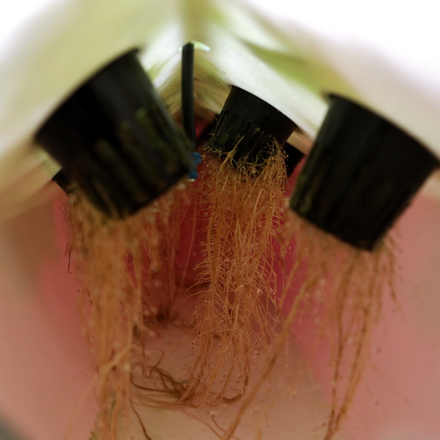
Yes, and it is a classic diagnostic mistake. Suffocated roots — brown or slimy — absorb nothing at all, regardless of how rich the water is. The leaf symptoms then look like a deficiency, but no supplement will correct them.

Remove a plant from the grow medium and take a look. White, firm roots point towards a genuine iron availability problem. Soft, dark roots point towards poor oxygenation, a blocked grow medium, or water that is too warm — all of which should be addressed as a priority before adding anything.

Planted aquarium products are often diluted chelates, designed for small volumes, which makes them expensive and impractical at the scale of an aquaponic system — though not actually harmful.

Iron fertilisers intended for lawns are a different matter. They frequently rely on iron sulphate, which is acidifying and non-chelated, and sometimes contain herbicides or additives that have no place in water where fish are living. If you have any doubt about a label, the safest decision is simply to leave it on the shelf.

Read next

Aquaponics and Summer Holidays

Aquaponics and Summer Holidays

You're going away for two weeks in July and your aquaponics system will be running without you : this thought rightly makes you anxious, because heatwaves, evaporation, and fish feeding raise practical questions. Good

Read the article
Salmonponics: aquaponics in cold water

Salmonponics: aquaponics in cold water

Aquaponics is often associated with pond fish like goldfish and koi. However, there is a variant perfectly suited for our temperate regions, cool climates, and winters : salmoponics. Trout, char, brook trout, these iconic

Read the article
Is aquaponics suitable for animal welfare ?

Is aquaponics suitable for animal welfare ?

We often talk about what aquaponics produces. But rarely about what the fish that make it work experience. Are they simply tolerated in a system designed for production, or can aquaponics truly respect their

Read the article
15 plants to grow in aquaponics

15 plants to grow in aquaponics

Aquaponics is ideal for growing a wide variety of plants, both indoors and outdoors. Some varieties adapt particularly well to this soilless growing method, with a constant supply of nutrient-rich water.

Read the article
Recognizing deficiencies in aquaponics

Recognizing deficiencies in aquaponics

In aquaponics, plants can show signs of weakness even when the system appears balanced. Pale leaves, slowed growth, or deformities are often linked to subtle yet critical micro-deficiencies. These deficiencies involve essential elements such

Read the article