Sold out


The Myfood City greenhouse covers 3.5 m² of floor space, under toughened glass, and grows your vegetables across 13 vertical growing towers fed by a 300 L pond. It fits on a large terrace or a roof terrace, and is also available from €51 per month. Orders and enquiries go through the Myfood website, in French, English or German.
Please specify your selection when ordering or by return email. The gift is dispatched by Univers Aquaponie, not by the retailer.

7/7 customer service by e-mail

Payment in instalments, free of charge
The City is the smallest aquaponic greenhouse in the range: 230 cm by 154 cm, giving a floor area of 3.56 m². It fits on a large terrace or rooftop where a traditional garden greenhouse simply would not. With a ridge height of 231 cm, a 300 L pond feeds thirteen vertical growing towers, and it is precisely this vertical approach that allows so many plants to be grown over such a small footprint, in a space you can still move around in comfortably.
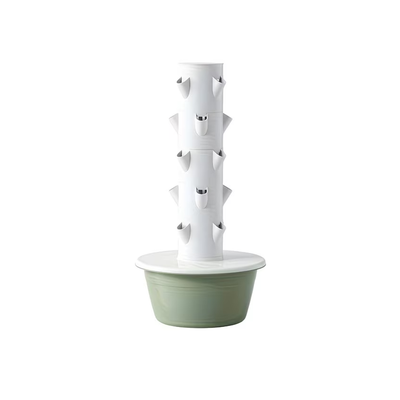
The question you may be asking is what you can actually grow in three and a half square metres. The answer lies in height: the 13 towers rise upwards rather than spreading out, in two sizes, 112 cm and 152.4 cm. You grow on columns, using the air rather than the ground, and a harvested lettuce immediately frees up a slot for the next one. It is a way of gardening through continuous rotation, with no downtime. In practice, you sow a few pots every fortnight and slot them into the spaces that open up, rather than planting everything in April. The two tower sizes are not chosen at random either: the taller columns take the crops you harvest frequently, at a comfortable hand height, and the shorter ones those you leave in place for several weeks.
The glazing is 4 mm toughened glass, not polycarbonate, and the structure typically withstands winds of 100 km/h and a snow load of 50 to 75 kg per square metre. These are the two figures to check if you live by the sea or at altitude, well before any question of yield. A roof vent and an automatic wax-actuator opener manage the heat, opening on their own when the temperature rises, which prevents an oversight on your part from cooking your crops on a Saturday in August. Toughened glass also has the advantage of not becoming hazy over the years, whereas polycarbonate eventually yellows and transmits less light. The wax actuator works by the expansion of a fluid and therefore requires no power supply, meaning it continues to function even during a power cut.
The greenhouse alone
The greenhouse weighs 300 kg, structure and toughened glazing included, before any water is added.
The pond under load
The whole unit reaches 700 kg once the pond and vertical growing system are fully filled with water.
The floor
The floor and the permaculture mounds, if added as an option, weigh an extra 200 kg.
What it involves
On a balcony or roof terrace, have the load-bearing capacity checked by a professional before ordering.
Load-bearing capacity should be checked before ordering
This is the point that truly sets a balcony greenhouse apart from a garden greenhouse. At ground level, 700 kg spread across a base raises no questions; on an upper-floor slab, it raises one, and that question is settled with the building management or a structural professional, not with a tape measure. Take this check seriously, as it is the only constraint of the City that cannot be addressed after the fact. Also check the clearance width along the route to the installation spot, as well as the building's regulations, since some restrict installations visible from the street.
Bacteria and testing for a new pond
The pond starts with water that does not yet contain any bacteria. Make sure you have something to seed the colony and a water testing kit: that is what will tell you when your fish can go in, and no calendar can ever replace it.
The 300 kg of the empty greenhouse is distributed across its footprint and presents little difficulty; it is the 400 kg of water added afterwards that requires a clear answer. Moving it a few metres is still possible before the water goes in, but once the pond is full it becomes a dismantling job. Choose your final position before commissioning, taking into account sunlight, access to a power socket, and a water point for top-ups. Also make sure you can walk around the greenhouse, or at least reach both sides, for harvesting and for opening the pond. If you add the floor and the growing mounds, add their 200 kg to the calculation too, a figure that is easily overlooked because it is installed after the greenhouse rather than alongside it.
The difference from a kitchen garden becomes clear after a few weeks. In a kitchen garden, you make every decision: when to water, what to fertilise, when to amend the soil. Here, you only control one thing, feeding the fish, and everything else adjusts on its own. Your thirteen towers will receive exactly what the 300 L pond produces, no more, no less. That means an under-stocked greenhouse produces pale plants, while an over-stocked one causes ammonium levels to rise before the bacteria can keep pace. On a small volume like this, that balance makes itself felt more quickly than on a larger installation, which is demanding at first, but an excellent way to learn. A weekly drop test is all it takes to stay on top of it. The three values to check are always the same: ammonium and nitrite, which must remain undetectable, and pH, which should sit between 6.8 and 7.2, a compromise between what suits the fish, the bacteria, and the plants.
A 5,000 L/h pump circulates water from the pond to the top of the towers, from where it flows back down by gravity through the roots. An electric ventilation unit at 300 m³/h moves air beneath the glazing. The whole system runs on 60 W from a standard 230 V 50 Hz socket: no need to upgrade your consumer unit to install it. The circuit runs continuously, including at night, because the bacteria that feed your plants do not stop either. Allow for a protected outdoor socket, and if your supply is prone to outages, bear in mind that a prolonged cut will deprive the towers of water well before the fish are affected, the roots have no reserve above the pond. A pump of this flow rate should also be rinsed once a season, as its strainer traps detached roots and fine particles of grow medium that will otherwise gradually reduce flow to the towers at the end of the line, with no other sign showing itself before the plants begin to struggle.
The 300 L HDPE pond is the engine of the entire greenhouse. The fish load the water with nitrogen, bacteria convert it, and the thirteen towers consume it. A volume of this size heats up and cools down faster than a garden pond, which needs monitoring in both summer and winter and determines your choice of species. It is also this volume that limits the fish stocking density, and therefore what your towers will receive: the ratio between the two is the real adjustment in aquaponics, and our guide on the nitrogen cycle explains what is at stake. The pond is topped up with fresh water in line with evaporation losses; this water should be left to stand or filtered through activated carbon when it is chlorinated, as a direct addition affects the bacterial colony before it harms the fish.
This volume is not suited to production fish-keeping, and the sensible approach remains a hardy ornamental stock kept at low density. Calculate your load in kilograms rather than by number of fish, around ten kilograms per cubic metre is already a cautious benchmark for such a small pond, and introduce them in stages to let the bacterial colony keep pace. Species that tolerate temperature fluctuations are better suited here than those requiring water held to within a degree, since a 300-litre pond under glass is more susceptible to daily variations than it is able to buffer them. In cold climates, monitor water temperature closely over winter and reduce feeding as the fish slow down, since uneaten food breaks down and loads the water at the worst possible time.
Three versions are available, and both the installation service and the connected controller can be added as options at the time of ordering. The first few weeks set the tone for everything that follows: the bacterial colony takes 4 to 6 weeks to establish, with an ammonia spike first, then a nitrite spike, before both drop back to zero as nitrates begin to appear. Plan on testing every 2 days during this period, then weekly thereafter, and record your readings rather than just noting them mentally, as a series of values shows how the nitrogen cycle is progressing in a way that a single measurement never can. Our guide to getting an aquaponic system started walks you through the readings that confirm the system is ready for fish, step by step.
The essentials
Heights, weights and stability
Equipment and power
To budget for separately
10 further specifications are available in the detailed view.
In the box
Dimensions, heights, weights, wind and snow resistance, flow rates and power consumption: figures stated by the supplier, recorded on 20/09/2026. The exact contents depend on the version and options selected at the time of ordering.
The two Myfood greenhouses from the catalogue, compared on the figures that matter before you order.
| Floor area (m²) | Volume of water in circulation (L) | Ridge height | Growing towers supplied | Ponds | Maximum power consumption (W) | Automatic vents | Price | |
|---|---|---|---|---|---|---|---|---|
| Recommended Myfood aquaponics greenhouse: City 3.5 m²Your choice | 3.56 m² | 300 L | 231 cm | 13 | 1 | 60 W | 1 | 478,100.00 RSD |
| Myfood aquaponics greenhouse: Family 11 to 44m²Your choice | 22.53 m² | 1200 L | 253 cm | 16 | 2 | 70 W | 4 | 1,126,400.00 RSD |
Dimensions and power consumption for the 3.5 m² City format and the 22 m² Family format, recorded on 20/09/2026. The 11 and 44 m² Family formats are not dimensioned here.
Help choosing
What are you going to rest it on?
Your estimate
It covers preparing your order and then the transit time quoted by the carrier, counted in working days.
It is not a guaranteed delivery date: public holidays, peak periods, customs or a carrier delay can extend it. The exact amount, in your currency, is worked out in the cart once your address is entered.
The greenhouse is delivered in sections and assembled on site. Installation is available as an option. Please mention at the time of ordering any upper-floor access, staircase or narrow passageway.
12 questions
6 key questions, 12 in the detailed view


Une question sur ce produit ou votre installation ? Notre équipe vous répond et vous conseille.

Paiement plusieurs fois sans frais
Proposé selon le montant du panier, au moment du paiement.

Livraison sous 5 à 15 jours ouvrés
Selon les produits et sites d'expédition. Estimation par destination dans l'estimateur de cette page.

SAV 7/7 par mail ou chat
Notre équipe répond à toutes vos questions.

Faire un achat engagé
Devenez acteurs du changement.


