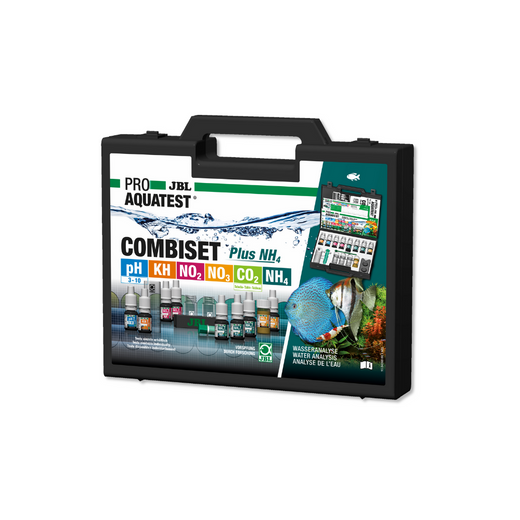

Reagent refill for total hardness GH test
Regular price
700.00 RSD
Regular price
Sale price
700.00 RSD
Unit price
/
per
233.33 RSD × 3 with no fees
Klarna.
This bottle is the titration reagent for the total hardness test, sold separately. It measures the calcium and magnesium in your water as a single combined value.
You add it drop by drop into 5 ml of water until the colour changes from red to green, with each drop equalling 1 °dGH. The test tube and sampling syringe from your kit remain in use.
 Customer support 7 days a week by email
 Delivery within 2 to 15 business days
100 % secure payment
The summary
- What it measures: total hardness, calcium and magnesium combined.
- Box contents: 1 bottle of titration reagent.
- How to read the result: count the drops until the colour changes from red to green.
- Greater precision: using 10 ml, each drop is worth only 0.5 °dGH.
- Equivalences: 1 °dGH equals 1.78 French degrees and 1.25 English degrees.
- Suitable water types: freshwater and garden ponds; not seawater.
The titration bottle on its own, one drop equals 1 °dGH, calcium and magnesium combined
Total hardness, or GH, adds together the calcium and magnesium salts dissolved in your water. This bottle is the titration reagent alone for the drop-based GH test, and it is used with the test tube and the sampling syringe from your kit, on fresh water and garden pond water.
Draw 5 ml of water with the syringe, then add the reagent drop by drop, swirling after each drop, until the colour changes from red to green. The number of drops gives the total hardness in German degrees, which also corresponds to 1.25 English degrees and 1.78 French degrees per drop. The colour change is immediate, so no waiting time is needed, and the whole measurement takes just a few minutes.
The GH reagent turns from red to green
The colour change of this bottle is the opposite of that for carbonate hardness, which shifts from blue to orange-yellow. Using one bottle in place of the other gives a plausible yet incorrect drop count, so read the label before each test series and store the two reagents in separate boxes.
📐 Read to the nearest half-degree
With soft water or reverse osmosis water that you are remineralising, one degree per drop remains a fairly coarse reading. In that case, take 10 ml instead of 5: each drop then equals only 0.5 °dGH, and you divide the total by two. The first drops colour a double volume less clearly, so place the test tube on a white surface to see the colour change distinctly. This adjustment is particularly useful when you are raising the hardness in small successive increments and checking each addition.
🌾 Calcium and magnesium for your crops
Most freshwater fish and plants do well between 8 and 25 °dGH. A garden pond often shows a lower hardness, as rainfall gradually dilutes the water over the seasons. In aquaponics, this value indicates how much calcium and magnesium your crops have available, and calcium is one of the elements that fish feed covers poorly; Epsom salt raises the magnesium component alone, without affecting the carbonates. The guide to deficiencies in aquaponics shows how these shortfalls appear on the leaves.
Measuring magnesium separately from calcium
The GH titration gives the combined total of calcium and magnesium, without indicating which of the two predominates. The magnesium test measures the second fraction on its own, and the difference between the two results tells you about the calcium level. You can then see whether your plants are short of magnesium even when the total hardness appears satisfactory.
📦 Storing the bottle
The reagent is classified Warning, with the hazard statements H226, H315, and H319: flammable liquid, skin irritation, and serious eye irritation. Store it tightly sealed, in a dry place at room temperature and in its original packaging, away from any naked flame. Since each test consumes as many drops as the water has degrees of hardness, water at 8 °dGH uses the bottle up twice as slowly as water at 16 °dGH, and the liquid level in the bottle is your best indicator of when to reorder.
Technical specifications
What the refill contains
- Contents
- 1 reagent bottleGH titration reagent, child-safety cap
- Value of one drop
- 1 °dGH per 5 mlWith 10 ml, one drop is worth only 0.5 °dGH
- Equivalences
- 1.78 °fH, 1.25 °eThe French degree is used in drinking water analyses in France
- Colour change
- From red to greenThe opposite of the carbonate hardness reagent, whose colour change goes from blue to orange-yellow
- Manufacturer's reference
- JBL 2410900, PROAQUATEST rangeNot to be confused with 2410800, which is the complete kit
- Hazard classification
- Please note, single bottleHazard statements H226, H315 and H319. Store dry, cap tightly closed, away from all ignition sources
To budget for separately
- Test tube and syringe
- Those from the total hardness testFilled to 5 ml, or to 10 ml so that one drop equals 0.5 °dGH
- How to remineralise
- Mineral salts, or Epsom saltThe first tests measure total hardness; the second measures only the magnesium fraction
In the box
- 1 bottle of GH titration reagent, with child-resistant cap
Reference, EAN code, contents, protocol, number of readings and hazard statements taken from the JBL data sheet and instructions on 07/10/2026. The 10 ml reading figure comes from the JBL FAQ. The number of readings per bottle depends on the hardness of the water being tested, as each reading consumes as many drops as the water has degrees of hardness.
Documents & manuals
Official manufacturer's instructions, in French
The four-step titration test protocol, reference volume and equivalences between German, English and French degrees. This is the kit's instruction leaflet, and it applies to the refill as well.
Document not showing? Some publishers block display inside a frame, so open it in a tab.
Estimate your
delivery time
Your estimate
Delivery
Estimated time
It covers preparing your order and then the transit time quoted by the carrier, counted in working days.
It is not a guaranteed delivery date: public holidays, peak periods, customs or a carrier delay can extend it. The exact amount, in your currency, is worked out in the cart once your address is entered.
Package weight 0.02 kg, dispatched to a collection point or to your home address, your choice at checkout. The bottle is sent in its original packaging. The exact shipping cost is shown in the basket.
Frequently asked questions
6 questions
6 key questions
You may also like


Related articles

Equipment
Which grow medium to choose for aquaponics?
Some grow media release calcium into the water, and that shows up in this reading.
Read the article

Start-up
Getting started with an aquaponic system
The baseline reading of your source water — the one almost nobody takes before filling up.
Read the article

Diagnosis
Plant deficiencies in aquaponics
Water that is too soft deprives plants of two major elements at once.
Read the article

Project
Setting up your aquaponic system
Choosing your top-up water is a decision, and it should be made with a proper reading.
Read the article

Pond
Koi carp in aquaponics
A pond diluted by rain loses its mineralisation, storm after storm.
Read the article

Guide
Aquaponics and hydroponics — what's the difference?
Two ways to mineralise growing water, and two ways to monitor it.
Read the article
Let us talk about your project
A question about this product or your setup? Our team will answer and advise you.

Interest-free instalment payments
Offered depending on the cart amount, at checkout.

Delivery in 2 to 15 working days
Depending on the products and shipping sites. Estimate by destination in the estimator on this page.

After-sales service 7 days a week by email or chat
Our team answers all your questions.

Shop responsibly
Become part of the change.
