Transporting your fish without stress

Written by Tristan Ulrich · October 18, 2026
Sachet de transport avec une carpe koï posé dans une caisse en polystyrène

The journey between the seller and your pond rarely lasts more than a few hours, but it is often the most dangerous moment in an ornamental fish's life. A few simple steps are enough to halve the risk, however.

Transporting your fish without stress

Taking a fish out of its tank, shutting it in a tiny volume of water, shaking it about for two hours and then releasing it into unfamiliar water: that is what transport looks like from the animal's point of view. The resulting stress is not merely unpleasant, it lowers the immune defences for several days.

This guide details each step, from fasting beforehand to the first meal after arrival, with the volumes, durations and thresholds to observe. You will also find the classic mistakes that turn an ordinary journey into a total loss, as well as the special case of large specimens and long distances.

Goldfish in a transport bag, close-up on stress

What a fish goes through during transport

Confinement, vibrations and light trigger a hormonal response involving cortisol, comparable in principle to that of mammals. The breathing rate speeds up, oxygen consumption increases and the protective mucus breaks down.

This mucus is the first barrier against parasites and bacteria. A fish that has been badly transported therefore arrives weakened and, even if it survives the journey, it often develops white spot or a bacterial infection within the following days or weeks. The aim is not to eliminate this stress, which is impossible, but to keep it low enough for the animal to recover in a few days rather than a few weeks. Everything that follows stems from this single principle.

Pond fish fasted before transport, feed bucket closed

Withhold food before departure

This is the most effective measure, and the one most often forgotten. A fish that has eaten just before departure keeps digesting during the journey, and so produces waste and ammonia in a closed volume of a few litres of water.

Allow at least 24 hours of fasting for a medium-sized fish, and 48 hours or more for a large specimen or a long journey. In cold water, the interval should be longer since digestion itself takes more time.

This fasting carries no risk. A healthy adult cyprinid can go several days without food, and it will arrive in a much cleaner bag. Remember to tell the seller if you are collecting the fish from them.

Filling the bag: little water and plenty of air

A transport bag is not filled like a bottle. Aquaculture guides and manufacturers recommend between one third and one quarter water to two thirds to three quarters gas, either ambient air or pure oxygen depending on the equipment available. This volume of gas is the reserve from which the fish draws by diffusion at the surface, and it is what determines the bag's real endurance.

  • One third water at most, two thirds gas or more.
  • Go down to one quarter water for a long journey.
  • Expel the air, then reinflate with pure oxygen if you have it.
  • Seal with a tight knot or two crossed elastic bands, never with a simple fold.
  • Check that the bag is watertight by gently turning it upside down before setting off.

Two points need making. Pure oxygen multiplies the bag's endurance but is rarely available to the home hobbyist, and a bag inflated with ambient air is perfectly adequate for a journey of a few hours. In addition, the exchange surface matters as much as the volume: a wide, shallow bag laid flat gives far better diffusion than a narrow one kept upright.

Transport bags for new fish with rounded corners Transport bags for fish, 20 x 50 cm

Choosing the right transport bag

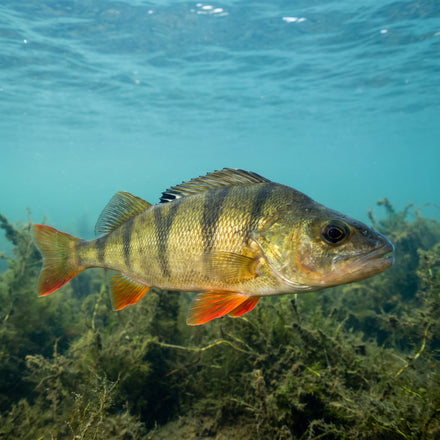
An ordinary freezer bag is not suitable. Bags designed for transporting fish are thick, flexible and above all free of sharp corners, because a fry or a stressed fish easily gets wedged in a pointed corner and injures itself there. For species with hard spines, such as perch, catfish or sturgeon, double-bagging is strongly recommended, with one bag slipped inside another. The dedicated transport bags come in several sizes, so choose wide ones rather than tall ones.

The bag should never be carried on its own. It goes inside a rigid container, such as a polystyrene box or a cool box, which prevents knocks, limits temperature swings and keeps the fish in the dark.

Three separate transport bags, each containing one goldfish

How many fish per bag

The permissible stocking density depends on the size of the fish, the temperature and the length of the journey, which rules out any universal rule. Aquaculture references quote very variable loads, from around twenty grams per litre for small tropical fish to more than 250 grams per litre for goldfish, always under pure oxygen and on short journeys. For domestic transport in ambient air, stay well below that. One 10 cm goldfish per 2 to 3 litres of water is a cautious guide, and a 25 cm koi deserves a bag to itself. Two principles are worth more than any calculation. Separate species and sizes, since even a small predator can injure a cramped companion, and always prefer several lightly loaded bags to a single full one.

Insulated cool box wrapped in a blanket in a car boot

Temperature, the limiting factor

After oxygen, this is the most decisive parameter, and the two are linked. Warmer water holds less dissolved oxygen while the fish consume more of it, with a doubling of consumption often cited for every ten degrees of extra warmth.

The aim is not to cool but to stabilise. An insulated box wrapped in a blanket is enough in most cases, and a passenger compartment kept between 15 and 20 degrees is far better than a boot exposed to the sun.

In midsummer, a cold plate placed on the lid, never in direct contact with the bag, prevents overheating. In winter, the opposite applies: never leave the box in a parked vehicle in sub-zero temperatures.

Ammonia and pH: the chemical trap inside the bag

A sealed bag is a microcosm whose chemistry changes quickly. The fish excretes ammonia through its gills, and because no biofilter converts it, it builds up, reaching worrying levels within just a few hours in a heavily stocked bag.

A less well-known phenomenon fortunately works in the opposite direction. The carbon dioxide released by respiration gradually acidifies the water in the bag, and below pH 7 the ammonia is overwhelmingly present in its ionised form, ammonium, which is far less toxic. This is precisely why you should never open a bag to let air in during the journey and then reseal it: the degassing raises the pH and instantly converts ammonium back into toxic ammonia.

The practical consequence is simple: a bag stays sealed from departure to arrival, and opening it coincides with the start of acclimatisation. If you are travelling a long distance, it is better to plan for a less heavily stocked bag at the outset than to hope to correct things along the way. Our article on the nitrogen cycle explains in detail the balance between these two forms depending on pH and temperature.

Fish transport crate in a car on a long journey

How long can the journey last

A bag inflated with ambient air and lightly stocked will generally withstand a journey of a few hours, which covers most purchases from a garden centre or a regional breeder. Under pure oxygen, with cool water and a low stocking density, professional guides describe shipments of twenty-four to forty-eight hours, sometimes with zeolite to bind ammonia, conditions that domestic equipment cannot reproduce.

So keep to a common-sense rule: beyond six hours, plan for a reinforced arrangement, such as oxygen, an aerated tub or a relay stop with a third party, rather than stretching an ordinary bag to breaking point.

Transport box wedged between two towels and covered with a blanket

Darkness and wedging the container in place

A fish placed in darkness spontaneously reduces its activity, and so its oxygen consumption and waste production. Closing the crate and laying a dark cloth over it is the most worthwhile step of the journey, at no cost. Wedging matters just as much. A crate that slides at every bend throws the fish against the wall of the bag; two rolled-up towels on either side are enough to hold it still. Place the whole thing on the floor behind a front seat, where swaying is least, rather than in the boot, which is more exposed to movement and temperature swings.

On the road: driving for your fish

The quality of your driving during the journey has a greater effect on the condition of the fish on arrival than most of the accessories you can buy. A calm journey, with no prolonged stops and no sudden temperature changes, remains the best guarantee.

  • Anticipate braking and take roundabouts very gently.
  • Keep the passenger compartment between 15 and 20 degrees, with continuous, gentle ventilation.
  • Never leave the vehicle in full sun during a break.
  • Keep stops to a minimum and head straight home, with no errands on the way.
  • Keep the box closed, with no unnecessary visual checks.

A word on regulations. The European regulation on the protection of animals during transport covers journeys linked to an economic activity, so it does not apply to a private individual bringing home their own fish. However, the animal health rules applying to aquatic animals govern commercial movements, and invasive alien species remain prohibited from being kept or transported. If you are buying across a border, check with the seller and with the competent authority in your country, as the requirements change regularly.

Large koi carp in a flexible tub with a battery-powered air pump Telescopic pond net, 40x35 or 50x43 cm

The case of large specimens

Beyond 30 centimetres, the bag reaches its limits. An adult koi carp, a sturgeon or a large trout travels far better in a flexible container or a rigid tank, filled to a third of its height, covered and fitted with a battery-powered aerator.

A small self-contained aerator keeps dissolved oxygen at a suitable level for several hours at modest cost, and is the only real safeguard on long journeys. Choose a fine air stone rather than a large diffuser, as the aim is surface area for gas exchange, not flow rate.

Handling itself deserves care. Use a large pond net, or better still a weighing sock for koi, and avoid keeping the animal out of the water for more than a few seconds.

Transport bag floating on the surface of the pond for acclimatisation

Acclimatisation on arrival

The sealed bag first floats for about thirty minutes on the pond or aquarium, in the shade, to equalise the temperature. Where the difference is large, professional guides advise going more slowly, at least two hours when the gap exceeds ten degrees.

Next comes chemical equalisation, which matters just as much. Open the bag and add a small volume of pond water about every ten minutes, in several stages, so as to gradually double the initial volume. This slowness is not excessive caution. A sudden difference in pH or hardness causes osmotic shock, the effects of which sometimes appear only forty-eight hours later, and our guide to pH regulation explains why such differences are so common between two installations.

Transferring a fish with a net without pouring in the transport water

Never pour out the transport water

This is the point on which almost every beginner goes wrong. The water in the bag is loaded with ammonia, mucus and potentially germs from the original setup, and it has no place in your pond.

The transfer should therefore be done with a net, or by pouring the contents of the bag into a bucket and then lifting out the fish alone. The leftover water goes down the drain, never into the natural environment or into a street gutter that empties into it.

This precaution ties in with the wider question of hygiene. Germs multiply in the water of a sealed bag as the hours go by, and a simple net avoids introducing them. The fish itself may also carry pathogens, which is why quarantine is worthwhile.

Anaesthetics and additives: what you need to know

Professionals sometimes use anaesthetics for long journeys or for handling large specimens. The substance lowers the metabolism, and therefore oxygen consumption and ammonia production, which mechanically extends how long a bag will last. Products of this type are available from specialist suppliers, such as anaesthetic solutions for fish, and they are genuinely useful in experienced hands.

For a domestic journey of a few hours, they are neither necessary nor recommended. The dose depends on the species, size, temperature and pH, the margin between light sedation and overdose is narrow, and a fish that is too deeply sedated can stop ventilating its gills. If you do use one, follow the instructions to the letter and have a well-oxygenated recovery tank ready.

Other additives should be judged case by case. Lightly salting the transport water, at a few grams per litre of non-iodised salt, is commonly done to limit osmotic stress, but it does not suit every species. Conditioners that neutralise ammonia are genuinely effective but only for a limited time, and they never replace fasting beforehand and a sensible stocking density.


Bare quarantine tank with air-lift filter and heater Pack of 5 aquaponics water tests: NH4, NO2, NO3, pH, KH

The first few days and quarantine

A newly arrived fish should not be fed on the same day. The next day, offer a very light ration, removing whatever is not eaten after a few minutes. Ideally, the newcomer does not join the stock directly. A bare quarantine tank, with an already seeded air-driven sponge filter, lets you observe the animal for several weeks and step in without treating the whole system. Specialist vets recommend at least thirty days, or about four weeks. Watch for three signs during this period: a fish that stays isolated in a corner, fins clamped against the body, rapid breathing at the surface. These signs call for an immediate check of the water with your test kits, ammonia and nitrite first of all, before any treatment.

Holding ponds at a European fish farmer's greenhouse

Buying and shipping across Europe

Many koi and pond fish come from breeders or wholesalers a long way away, sometimes based in another European country. Buying at a distance therefore often means a journey of several hundred kilometres. In that case, shipping by a professional equipped with oxygen is better than an improvised round trip. Always ask for the packing date of the parcel, the time it was handed to the carrier and the delivery commitment: a bag prepared the previous evening does not have the same endurance as one sealed that very morning.

Climate differences also matter. A summer transport between southern Spain and northern Europe, or the reverse in the depths of winter, calls for a much more gradual thermal acclimatisation on arrival.

Conclusion: prevention is better than cure

A successful transport does not rely on any expensive equipment. Fasting beforehand, a properly filled bag, a closed and wedged box, a short journey and a slow acclimatisation cover almost every situation a home hobbyist will meet.

The mistakes that cost the most are the ones people think are harmless: opening the bag on the way, pouring the transport water into the pond, releasing the fish ten minutes after arrival or offering it a meal the same evening. Each of them adds stress to an animal that can no longer afford it.

Finally, remember that success is measured not on arrival but two weeks later. A fish that feeds normally, swims with the group and shows no lesions has truly travelled well, and it is quarantine that will tell you so.

Sources

Southern Regional Aquaculture Center, Transportation of Warmwater Fish: Procedures and Loading Rates (SRAC 392), Gradual temperature acclimatisation and light salinisation of the transport water

Southern Regional Aquaculture Center, Shipping Fish in Boxes (SRAC 3903), Fasting for at least 24 hours, stocking densities per litre, zeolite against ammonia

North Central Regional Aquaculture Center, Transportation of Fish in Bags (NCRAC 104), Metabolism doubled for every ten degrees' rise, gas proportions, floating the bag, times under oxygen

University of Florida IFAS Extension, On-Farm Transport of Ornamental Fish (FA-119), Rise in carbon dioxide and drop in pH inside the bag, slow acclimatisation beyond a ten-degree difference

University of Florida IFAS Extension, Preparation of Ornamental Fish for Shipping (FA-120), Prior fasting and bacterial growth in the transport water

Tetra, Fish transport and acclimatisation, Filling the bag and gradually adding pond water on arrival

AZEAH, New Koi Quarantine Recommendations, Quarantine of at least thirty days for koi

EUR-Lex, Regulation (EC) No 1/2005 on the protection of animals during transport, Exclusion of journeys not related to an economic activity

Frequently asked questions

This is a common practice in aquaculture, adopted to reduce the effects of transport stress. North American data sheets mention low concentrations, in the order of a few grams per litre, a range that freshwater fish tolerate well. For a hobbyist moving two or three fish on an hour's drive, the benefit is marginal and the risk of a dosing error very real. So keep salt for long journeys, and only after checking the exact protocol.

Yes, this is the usual way breeders send fish, with a bag inflated with oxygen and an insulated box. Insist on 24-hour delivery, dispatch early in the week and handover in person. Avoid heatwaves and frosts, and agree in advance what happens if a fish arrives dead.

Do not put it straight back into the pond and avoid any handling. Finish the acclimatisation, then place it in a calm, dark and well-aerated volume of water.

The absolute priority is dissolved oxygen, which aquaculture references recommend keeping above five milligrams per litre. An exhausted fish often recovers within a few hours under gentle aeration. If it has not righted itself after a night, look to osmotic shock or ammonia poisoning rather than disease.

The journey is only half the problem. A filter that is still immature lets ammonia and then nitrites climb in the days after introduction, and an animal already stressed by the trip copes with it very badly. Wait for a full cycle, with ammonia and nitrites undetectable on two readings taken some time apart, before you collect your fish.

No. The feed would immediately produce waste and ammonia in a closed volume, exactly what the fasting beforehand was meant to avoid.

Invertebrates travel in their own bag, for two reasons.

  • They cope poorly with swings in hardness and pH, and their acclimatisation needs to be even slower than a fish's.
  • A shell or a leg can puncture the film, hence the value of a double layer and a piece of filter foam to cling to.

Also plan for a container that is less full, as these species benefit more from a generous volume of water than from a squeezed bag.

Read next

Protecting your aquaponic system in winter

Protecting your aquaponic system in winter

Winter is a critical period for an aquaponic system: the pond may freeze, bacterial activity collapses and the fish's metabolism slows right down. With the right habits and a minimum of equipment, you can

Read the article
Raising perch in aquaponics

Raising perch in aquaponics

The common perch is the predatory fish of European temperate waters: hardy, with sought-after flesh, and perfectly suited to aquaponic systems in temperate climates. Here is how to raise this fish, the temperatures to

Read the article
Kratky Method : Passive Hydroponics Without a Pump

Kratky Method : Passive Hydroponics Without a Pump

Pump-free, electricity-free, and intervention-free hydroponics, that's the astonishing promise of the Kratky method. A minimalist approach based on a simple physical principle that opens up soilless cultivation to all gardeners, from curious beginners to

Read the article
Growing without soil in hydroponics

Growing without soil in hydroponics

Hydroponics is not a trend but an agronomic revolution thousands of years old, using up to 90% less water and supporting faster plant growth. Understanding its principles, methods and limitations is becoming essential for

Read the article
Solar aquaponics, a self-sufficient system

Solar aquaponics, a self-sufficient system

The sun can do far more than power a pump: it oxygenates the tank, circulates the water, cooks the fish and dries the herbs from the harvest. Here is how to make a small

Read the article
UV steriliser for ponds

UV steriliser for ponds

A pond UV steriliser eliminates the single-celled algae responsible for green water, provided it is correctly sized and fitted at the right point in the circuit. This guide covers the power to choose, the

Read the article

Discover our aquaponics greenhouses and kits:

View all
Produits du rayon Kits d'aquaponie chez Univers Aquaponie

Aquaponics kits

Aquaponics kits ready to install in the garden, on a patio or in a greenhouse, with fish tank, grow beds and pump.

Discover
Produits du rayon Univers Plantes chez Univers Aquaponie

Plants

Seeds, grow media, fertilisers and aquatic plants for successful growing in aquaponics, hydroponics and the vegetable garden.

Discover
Produits du rayon Univers Équipements chez Univers Aquaponie

Equipment Universe

The equipment that keeps a system running: soilless growing, water circulation and aeration, filtration, temperature, plumbing and lighting.

Discover
Produits du rayon Serres d'aquaponie chez Univers Aquaponie

Aquaponics greenhouses

Greenhouses designed for aquaponics, supplied with their fish tank and grow towers.

Discover
Produits du rayon Univers Poissons chez Univers Aquaponie

Fish

Feed, monitor the water and care for your pond, aquarium or aquaponic fish.

Discover
Produits du rayon Univers Formation chez Univers Aquaponie

Learning

Books and practical courses on aquaponics, hydroponics and food self-sufficiency.

Discover