Testing the water in aquaponics

Written by Tristan Ulrich · November 25, 2026
Analyse colorimétrique de l'eau d'un système aquaponique

A few drop tests are enough to tell whether the fish, bacteria and plants in an aquaponic system are living in water that suits them. This guide gives the target values for each parameter, how to read them together, how often to test from start-up through to routine, and what to do after an abnormal result.

Testing the water in an aquaponic system

Clear water can contain ammonia, and slightly cloudy water may pose no danger to the fish. Only a measurement can tell. The FAO guide to small-scale aquaponics therefore recommends simple water tests in every installation, with a reading each week to check that all the parameters stay within range.

Each parameter affects the others. The pH determines the toxic fraction of the ammonia, temperature limits the oxygen the water can hold, and KH decides whether the pH will hold steady. A value should therefore always be read alongside the others from the same day.

Fish in a planted tank with balanced water

Three inhabitants, a single body of water

Fish, nitrifying bacteria and plants share the same water without having the same needs. The FAO publishes the tolerance of each. Plants prefer a pH of 5.5 to 7.5, fish and bacteria tolerate 6 to 8.5, and cold-water fish need less than 0.1 mg/L of nitrite whereas warm-water fish tolerate up to 1 mg/L. For temperature, the same table gives 22 to 32 °C for warm-water fish, 10 to 18 °C for cold-water fish, 16 to 30 °C for plants and 14 to 34 °C for bacteria.

Aquaponics therefore depends on a compromise, a range in which each organism works properly without being at its optimum. The guidelines that follow are those of this compromise, and the article on the nitrogen cycle explains how the fish's ammonia becomes the plants' nitrate.

The target values in aquaponics

The FAO compromise table gives one value for each parameter. For pH, the shop uses a slightly wider range, from 6.4 to 7.5, which leaves more room for nitrification.

  • pH from 6.4 to 7.5, with the FAO placing the optimum at 6 to 7.
  • Ammonia below 1 mg/L, and close to zero in an established system.
  • Nitrite below 1 mg/L, also close to zero.
  • Nitrate from 5 to 150 mg/L.
  • KH and GH from 60 to 140 mg/L expressed as calcium carbonate, or roughly 3 to 8 °dH.
  • Dissolved oxygen above 5 mg/L.
  • Temperature from 18 to 30 °C, to be set according to the fish being raised.
Drop of reagent added to a vial to measure nitrite

Sample and dose without any risk

A colorimetric test is carried out on a sample, never in the tank. The FAO describes the procedure, 5 to 10 drops of reagent in 5 ml of water, for a reading in under five minutes. Take all your samples at once, from the middle of the tank and at the same time of day on each occasion, and read the colour in daylight against a white background. Several reagents are corrosive, flammable or toxic to aquatic life. They stay in the test tube and never go into the fish water, then the test tube is emptied down the sink and rinsed.

Five test vials lined up in a gradient from yellow to dark green Ammonium NH4 water test, drop format

Ammonia, a toxicity governed by pH

Ammonia is the first nitrogenous waste produced by fish. A drop test measures total ammonia nitrogen, that is, ammonium, which is only mildly toxic, plus free ammonia, the form that burns the gills. The NH4 ammonium drop test reads from 0.05 to 5 mg/L, fine enough to pick up a trace during start-up.

The toxic share depends on pH and temperature. According to a fact sheet from the Southern Regional Aquaculture Center in the United States, at 20 °C free ammonia makes up 0.4% of total ammonia nitrogen at pH 7, 3.8% at pH 8 and 28% at pH 9, which is roughly ten times more with each pH unit. The same reading is therefore almost harmless in slightly acidic water and worrying in hard water.

The FAO asks for ammonia close to zero, 1 mg/L at most, and reports poisoning in tilapia and carp from 1 mg/L. Above 4 mg/L, ammonia also slows the nitrifying bacteria. During a spike, cut the feed ration sharply and never raise the pH, as this would increase the toxic share.

Carp gasping at the surface, gills affected by nitrite

Nitrite and brown blood disease

Nitrite, an intermediate stage of nitrification, passes into the blood through the gills and prevents haemoglobin from carrying oxygen. The blood then turns a chocolate-brown colour, hence the name brown blood disease. The FAO reports problems from 0.25 mg/L and sets 1 mg/L as the ceiling, with less than 0.1 mg/L for cold-water fish such as trout.

An affected fish may gulp air at the surface in water that is nonetheless rich in oxygen, and a nitrite test tells the two causes apart. In fish farming, salt slows the passage of nitrite into the blood. In aquaponics, that salt would never leave the circuit that waters the crops, so it is not added. The first step is to reduce the feed ration and change part of the water.

Green leaves of a crop fed by nitrate

Nitrate, the plants' food ration

Nitrate is the main source of nitrogen for the crops, and according to the FAO, fish can tolerate up to 300 mg/L. The guide recommends keeping it between 5 and 150 mg/L and replacing part of the water above that, since more than 250 mg/L harms plants. A nitrate level that climbs week after week indicates a feed ration too high for the cultivated area, and adding a grow bed is then often better than emptying out the water. A nitrate level that stays at rock bottom points to a young, lightly stocked or heavily planted system.

Colorimetric pH test for the water of an aquaponic system

The pH, always measured at the same time

Nitrification acidifies the water, and an aquaponic system gradually becomes more acidic as a result of this bacterial activity, as the FAO points out. The guide explains that between 6.0 and 6.5 all nutrients are readily available to plants, that bacteria struggle below 6, and that a pH below 5 or above 8 quickly becomes critical for the whole system. A dense fish stocking also releases more carbon dioxide, which lowers the pH, according to the same guide.

In a planted bed, the pH rises during the day, when photosynthesis uses up the carbon dioxide, and falls again at night. The swing commonly reaches several tenths of a unit, so a reading can only be compared with one taken at the same time of day. Corrections are covered in the article on how to regulate pH in aquaponics, and leaves that turn yellow despite a correct nitrate level are often explained by the pH, as the article on iron deficiency describes.

Drop of reagent falling into a vial of water during a carbonate hardness test KH water test, carbonate hardness, drop-based

KH, the reserve that holds the pH

KH, or carbonate hardness, measures the dissolved carbonates. They neutralise the acidity produced by nitrification, and the FAO describes KH as a buffer that resists a fall in pH. Without enough KH, pH can change quickly, even dropping overnight once the carbonates are used up.

The guide puts the optimum between 60 and 140 mg/L of calcium carbonate, or roughly 3 to 8 °dKH. As nitrification uses up this buffer continuously, keep a margin above 5 °dKH. The KH carbonate hardness drop test is read by titration, with one drop equal to 1 °dKH, and it should be done every week alongside the pH test.

To raise KH, the FAO recommends calcium carbonate, in the form of crushed, rinsed eggshells or seashells, or crushed limestone, placed in a porous bag hung in the sump tank and removed when the pH goes above 7. The guide also suggests two to three handfuls of these materials per 1,000 L, with pH monitoring over the following weeks. Potassium bicarbonate also raises KH and supplies potassium to the crops, at around 36 g per 1,000 L for each degree gained. The guide rules out sodium bicarbonate in aquaponics, because the sodium it adds harms the plants.


Coloured test tubes after analysing pH, KH and GH

GH, not to be confused with KH

GH, or total hardness, is the sum of the dissolved calcium and magnesium. It does not buffer pH, so raising GH stabilises nothing. The FAO considers it to have no effect on the health of the organisms and useful as a source of trace elements, with the same optimum of 60 to 140 mg/L. The case to watch is very soft water, rainwater or reverse-osmosis water, with almost no calcium or magnesium, which the FAO advises buffering before use, as the article on rainwater in aquaponics explains in detail.

Aquaponic pond in full sun, a carp near the surface

The temperature, set for the fish

The FAO recommends a compromise range of 18 to 30 °C. Warm-water fish such as tilapia, common carp or catfish thrive, as do the nitrifying bacteria, between 22 and 29 °C, whereas trout cannot tolerate more than 18 °C. The species you keep therefore sets the target, as the article on choosing your fish shows.

Temperature also changes how you read the other tests. Warm water holds less dissolved oxygen and more toxic ammonia, according to the same guide. Note it down at every reading, with a thermometer left in the tank.

Ceramic air diffuser releasing a column of fine bubbles

Oxygen, a separate test

Dissolved oxygen should stay above 5 mg/L according to the FAO, and it is the parameter whose shortage has the most immediate effect on fish. Its drop test requires a sample taken by immersion, without an air bubble, since a trapped bubble would skew the reading upwards. Without an oxygen meter, the FAO acknowledges that small systems often rely on observing the fish and plants. The guide to dissolved oxygen in aquaponics covers the thresholds for each inhabitant, the time of measurement and aeration.

Water surface of an aquaponic system Digital pocket EC and TDS conductivity tester

The conductivity, a trend to follow

Electrical conductivity, or EC, measures the total amount of dissolved salts without saying which ones. A pocket EC and TDS conductivity tester reads it in a few seconds, in microsiemens per centimetre, bearing in mind that 1 mS/cm equals 1,000 µS/cm. Record the EC rather than the TDS, whose conversion to ppm varies from one device to another. Measure the pH on the same day, since EC tells you how many nutrients the water contains, and pH tells you whether they remain available to the roots.

Its value in aquaponics lies in the trend. An EC that rises week after week shows that salts are accumulating, because evaporation carries off the water and leaves the minerals behind, and that a partial water change is becoming worthwhile. An EC that stays very low signals, on the contrary, a system that is still poor in nutrients.

Start-up testing, week by week

During cycling, the FAO advises measuring nitrogen every 2 to 3 days and plotting the values on a graph. Ammonia rises first. The first bacteria establish themselves in the five to seven days following the first input, nitrite rises about five to seven days later, then falls again as the second family of bacteria becomes established.

Cycling is complete when nitrate rises steadily, nitrite is at 0 mg/L and ammonia stays below 1 mg/L, which takes about 25 to 40 days in good conditions. The fish arrive only when ammonia and nitrite are both below 1 mg/L, and in small groups, because a second, weaker peak may follow. Above 1 mg/L, the FAO advises a water change.

A daily reading of ammonium and nitrite during the first three weeks, at the same time each day, tightens this monitoring. pH and KH are checked every day in the first week and then weekly, and nitrate weekly from the moment the system is filled. Starting up the filter itself is detailed in the guide to filtration in aquaponics.

Tests for pH, ammonium, nitrite, nitrate and KH of aquaponics water Pack of 5 aquaponics water tests: NH4, NO2, NO3, pH, KH

The routine of an established system

Once cycling is complete, the FAO puts pH, nitrate, KH and temperature at the top of the week's measurements, because they tell you whether the system is staying in balance. Its weekly task list adds ammonia and nitrite, measured before feeding the fish, and these are also the first tests to reach for at the slightest doubt.

The pack of 5 water tests for aquaponics brings together ammonium, nitrite, nitrate, pH and KH in separate boxes, which can be bought again one by one. An old, stable system can space out its tests, as the FAO accepts that they are then only needed in case of doubt, but go back to daily testing after every addition of fish or pump failure. Complete the kit with a thermometer and, during hot spells, an oxygen test.

Water parameter logbook

A notebook for reading the trends

The FAO advises noting down each reading in a dedicated notebook, to follow trends from one season to the next. Record the date, the time, the temperature and the latest intervention, whether topping up water, adding new fish or cleaning the filter. A pH that drops by a tenth each week or a nitrate level that climbs steadily shows up over six weeks of readings, well before it becomes a problem. A graph, like the one the FAO advises keeping during cycling, makes the trend readable at a glance.

Fish lethargic at the bottom of a tank

The fish, the first indicators

The FAO advises watching the behaviour and appearance of the fish at every feed, and checking plant growth every day. A fish that refuses its ration, sits listless on the bottom or gulps for air at the surface, or a plant that yellows or slows down, will often signal a problem before the next scheduled test. The same guide states that this observation complements testing rather than replacing it, and that ammonia and nitrite are the first tests to run as soon as a problem appears.

Garden hose pouring tap water into a pond

Top-up water and its chlorine

According to the FAO, an aquaponic system consumes on average 1 to 3% of its water volume per day, on top of evaporation and splashing. The mains water used to top it up contains chlorine or chloramine. Chlorine escapes if the water is left to stand for 48 hours or more, and does so faster under an air bubbler. Chloramine, which is more stable, calls for a carbon filter or a water conditioner.

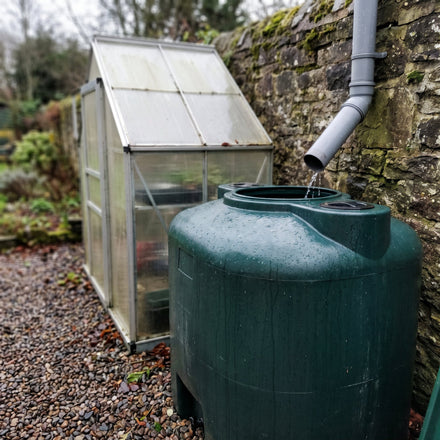
The FAO advises never replacing more than 10% of the water without first testing and dechlorinating it. A carbon anti-chlorine filter connected to the tap lets you pour in filtered water without waiting. Rainwater contains no chlorine, but it arrives with almost no KH or GH and needs buffering before use.

Well water is often slightly alkaline, between pH 7 and 8. The FAO considers it dangerous to pour acid into the system, because it reacts first with the buffer without the pH moving, then makes it drop all at once. If you need to acidify, add the acid to top-up water stored separately, always acid into water and never water into acid, and never use citric acid.

Reading an abnormal result

An out-of-range result should first be confirmed with a second measurement, then read alongside the other values for the day. The most common cases call for simple actions.

  • Ammonia or nitrite above 1 mg/L. Reduce the feed, change part of the water, and check the oxygen and the size of the biofilter.
  • pH below 6. The FAO advises adding a base or increasing the KH, always slowly, then monitoring the pH over the following weeks.
  • pH that drops every week. The KH is being used up, so replenish it before the drop.
  • Nitrate above 150 mg/L. Add more crops or replace part of the water.
  • Yellow leaves with a normal nitrate level. Check the pH before adding any fertiliser.
  • Fish at the surface and oxygen normal. Test the nitrite.
Test tubes for checking the water of an aquaponic system

Drops, test strips or electronic

The FAO classes test strips as the cheapest and moderately accurate option, drop tests as easy to find and use, and digital meters as expensive and very accurate. In aquaponics, drop tests remain the foundation, especially as the 7-in-1 strip does not read ammonium, the first toxic compound in a system that is starting up. An electronic pH meter is only as good as its calibration with buffer solutions. The water test comparison looks at these tools in detail.

Conclusion: regular, recorded tests

Testing the water in an aquaponic system takes very little equipment. Weekly checks of pH, KH, nitrate and temperature are enough for an established system, with ammonia and nitrite added at start-up and at the slightest doubt. The FAO guidelines give the target, which in practice means a pH held between 6.4 and 7.5 and a KH kept above 5 °dKH.

A logbook does the rest, because a series of readings reveals a drift weeks before the fish suffer from it.

Sources

FAO, Small-scale aquaponic food production, Technical Paper 589 (Somerville et al., 2014), section 3.1, Working within the tolerance range for each organism (tables 3.1 and 3.2), Tolerances of fish, plants and bacteria, compromise values for aquaponics.

FAO, Small-scale aquaponic food production, Technical Paper 589 (Somerville et al., 2014), chapter 3, The five most important water quality parameters, Thresholds for ammonia, nitrite and nitrate, pH and nitrification, temperatures, KH and GH.

FAO, Small-scale aquaponic food production, Technical Paper 589 (Somerville et al., 2014), chapter 3, Water testing, Priority tests of the week, how to do the drop test, test strips and meters, monitoring logbook.

FAO, Small-scale aquaponic food production, Technical Paper 589 (Somerville et al., 2014), chapter 3, Sources of aquaponic water, Chlorine and chloramine, the 10% rule, consumption of 1 to 3% per day, rainwater and reverse osmosis water.

FAO, Small-scale aquaponic food production, Technical Paper 589 (Somerville et al., 2014), chapter 3, Manipulating pH, Raising KH with calcium carbonate, a slow correction, with sodium bicarbonate ruled out.

FAO, Small-scale aquaponic food production, Technical Paper 589 (Somerville et al., 2014), chapter 5, System cycling and starting a biofilter colony, Testing schedule during cycling, appearance of nitrite, end of cycling, introduction of the fish.

FAO, Small-scale aquaponic food production, Technical Paper 589 (Somerville et al., 2014), chapter 8, Routine management practices, Weekly tests before feeding, with readings noted down.

Southern Regional Aquaculture Center, SRAC 463, Ammonia in Fish Ponds (Durborow, Crosby and Brunson), Proportion of free ammonia according to pH at 20 °C, multiplied by ten with each pH unit.

Frequently asked questions

No. Several reagents are toxic to aquatic life, and the test tube should always be emptied down the sink, then rinsed.

The discrepancy often comes from the measurement itself.

  • A pH meter that has not been calibrated for a long time drifts, and it is recalibrated with buffer solutions.
  • A colour read under artificial lighting looks shifted, hence the advice to read it in daylight.
  • Two measurements taken at different times in a planted tank concern two different bodies of water.

Yes. The FAO ranks it among the four most important measurements of the week, because it shows whether the feed ration and the cultivated area remain in balance. Rising nitrate signals a shortage of crops before the water exceeds 150 mg/L, and falling nitrate signals plants that are going to run short of nitrogen.

First, look at what the routine reading does not pick up. Oxygen is measured separately, and warm water holds less of it. A top-up of non-dechlorinated mains water, added just before the symptoms appeared, is another common lead.

Also re-read the ammonia alongside the pH and temperature from the same day. A modest result becomes worrying in hard, warm water. If everything else looks fine, watch the fish closely and seek the advice of a vet.

A balanced aquaponic system only needs topping up with the water it loses. A partial water change is a response to a measurement: nitrate above 150 mg/L, ammonia or nitrite above 1 mg/L, or conductivity that climbs week after week.

Fresh water is dechlorinated before it enters the circuit, and the FAO advises never replacing more than 10% without first testing it and removing its chlorine.

That nothing is holding the pH any more. Raise the KH in small doses, then measure again the next day rather than straight away.

Read next

Rainwater in aquaponics

Rainwater in aquaponics

Rainwater is free, readily available and perfectly suited to watering, but introducing it into an aquaponic system calls for a few very specific precautions. Here is how to collect it, test it and use

Read the article
Filtration in aquaponics

Filtration in aquaponics

An aquaponic system filters its water twice: first to catch the solid fish waste, then to hand the dissolved ammonia over to the bacteria that convert it into nitrate for the plants. This guide

Read the article
Choosing your pump for aquaponics

Choosing your pump for aquaponics

The pump circulates the water from the fish tank to the plants day and night, and a poor choice costs you in lost flow rate, wasted electricity or fish short of oxygen. This guide

Read the article
Solar aquaponics, a self-sufficient system

Solar aquaponics, a self-sufficient system

The sun can do far more than power a pump: it oxygenates the tank, circulates the water, cooks the fish and dries the herbs from the harvest. Here is how to make a small

Read the article
What to sow in autumn in aquaponics

What to sow in autumn in aquaponics

Autumn is not the end of the growing season, it is the start of the most peaceful one. Here is what to sow, when to do it and how to achieve leaf harvests through

Read the article
Growing pots for aquaponics

Growing pots for aquaponics

The net pot is an unassuming but decisive accessory in aquaponics: it supports the plant, houses the grow medium and allows water and oxygen to circulate freely. This guide explains how to choose the

Read the article

Discover our aquaponics greenhouses and kits:

View all
Produits du rayon Kits d'aquaponie chez Univers Aquaponie

Aquaponics kits

Aquaponics kits ready to install in the garden, on a patio or in a greenhouse, with fish tank, grow beds and pump.

Discover
Produits du rayon Univers Plantes chez Univers Aquaponie

Plants

Seeds, grow media, fertilisers and aquatic plants for successful growing in aquaponics, hydroponics and the vegetable garden.

Discover
Produits du rayon Univers Équipements chez Univers Aquaponie

Equipment Universe

The equipment that keeps a system running: soilless growing, water circulation and aeration, filtration, temperature, plumbing and lighting.

Discover
Produits du rayon Serres d'aquaponie chez Univers Aquaponie

Aquaponics greenhouses

Greenhouses designed for aquaponics, supplied with their fish tank and grow towers.

Discover
Produits du rayon Univers Poissons chez Univers Aquaponie

Fish

Feed, monitor the water and care for your pond, aquarium or aquaponic fish.

Discover
Produits du rayon Univers Formation chez Univers Aquaponie

Learning

Books and practical courses on aquaponics, hydroponics and food self-sufficiency.

Discover