NFT system in hydroponics

Written by Tristan Ulrich · November 24, 2026
Système hydroponique NFT avec rangées de gouttières et laitues romaines en culture

In an NFT system, a thin film of nutrient solution flows continuously along the bottom of a sloping gutter and feeds bare roots, with no grow medium at all. This guide details the settings that make the method work at home, from slope to flow rate, from pH to power cuts, through to its use in aquaponics.

The nutrient film: substrate-free growing

In an NFT system, short for nutrient film technique, plants have no soil, no clay pebbles and no deep water bed. Their bare roots rest at the bottom of a slightly sloping channel, where a thin film of nutrient solution, only a few millimetres deep, flows continuously before dropping back into the sump tank. This simplicity is its strength, since there is no grow medium to buy, rinse or throw away. It is also its weakness, because nothing holds water around the roots if circulation stops.

The sections that follow go through the method step by step for a home installation, from the slope of the channels to their flow rate and length, from the crops that suit the system to preparing the solution, from monitoring pH and EC to what to do when the power goes off. They also cover maintenance between crops, the use of NFT in aquaponics and how it compares with other systems, with benchmarks drawn from the FAO, several universities and the manufacturer Nutriculture.

Long rows of growing gutters inside a large commercial greenhouse

Where the nutrient film comes from

The technique was developed in England by Allen Cooper, a researcher at the Glasshouse Crops Research Institute in Littlehampton, a public centre devoted to greenhouse crops. The idea seemed risky, since it did away with any grow medium and entrusted the plant's nutrition to a thin stream of moving water. It nevertheless caught on, and nutrient film technique has become one of the most widespread soilless growing methods in the world, particularly for salads grown under cover.

Mat of white roots spread along the bottom of a gutter, seen from the inside

A stream beneath the roots

The system is closed. A pump submerged in the sump tank lifts the solution to the top end of each channel, then the water runs down the slope by gravity, bathes the roots as it passes and falls back into the sump tank, from where it starts again. The plants are held by the perforated lid of the channel, in a small basket or a block of rock wool, and their roots spread out in a mat along the bottom.

The whole principle rests on the shallow depth of the water film. Only the lower part of the root mat sits in the solution, while the upper part stays in the humid air of the channel, so the roots have water, nutrients and oxygen at the same time. This is also why NFT copes poorly with excess water. A channel that fills up instead of draining deprives the roots of air.

White gutters in a row carrying lettuces in continuous cultivation

What NFT offers, and what it demands

The first advantage is the absence of grow medium. You buy neither clay pebbles nor coconut fibre, the channels are easy to drain and clean, and the installation stays light, which makes it possible to stack several levels of channels on a single frame. Plants are also easier to handle, since they come out of the channel with their net pot, roots included, with no grow medium to untangle. The solution recirculates constantly, so the water used is mainly what the plants absorb and transpire.

The downside is the lack of buffering capacity. A channel holds almost no water, and its temperature follows that of the room or greenhouse. Oregon State University points out that these shallow channels react quickly to swings in ambient temperature, and that a pump failure or a power cut can make plants wilt immediately.

NFT therefore suits anyone who can check on their setup every day and is happy to depend on a pump, and it performs best with the lettuces and herbs it was designed for. For a first experience without electricity, the Kratky method is more forgiving.

The three settings that decide everything

An NFT installation comes down to three settings, slope, flow rate and length, plus the channel profile and the spacing between plants. Not all sources quantify them in the same way, and here are the benchmarks they give.

  • Slope of 1 to 4%, that is 1 to 4 cm of drop per metre of channel, with at least 2% according to Oregon State University.
  • A low, continuous flow rate, never more than 1 to 2 litres per minute per channel according to the FAO.
  • Length of 1 to 12 m according to the FAO, and 1.2 to 3.7 m for the small systems described by the Virginia Cooperative Extension.
  • Tube 7.5 cm in diameter for lettuces and small vegetables, 11 cm for larger plants.
  • At least 21 cm between the centres of two planting holes, according to the FAO.

These ranges overlap more than they conflict. A gentle slope is enough on a short, rigid channel, whereas a steeper slope helps the water get past a thick root mat. The FAO flow rate is a ceiling, and a small domestic channel runs very well on much less.

Spirit level placed on a white gutter to check its slope

The slope to the nearest centimetre

The slope moves the water along without letting it build up. Too shallow, and it leaves puddles where the solution stagnates and loses its oxygen. Too steep, and it speeds up the flow, which runs under the roots without wetting them all. The FAO recommends about 1 cm per metre for its aquaponic gutters, Cornell describes channels inclined at 1 to 4%, and Oregon State University sets a minimum of 2% for horizontal gutters. On a 2 m gutter, a 2% slope puts the inlet 4 cm higher than the outlet.

Set it with a spirit level and a tape measure, on a stable frame standing on level ground. Check the slope at several points, because a gutter that sags between two supports forms a dip where the water stops. Nutriculture, by contrast, asks for its Gro-Tank systems to be placed on a perfectly level surface, as the slope is already moulded into the tray.

Rows of green lettuces in the gutters of a modern hydroponic greenhouse

A low flow rate, but constant

The flow rate is set channel by channel, and it is much lower than you might imagine. The FAO sets a ceiling of 1 to 2 litres per minute for each channel, and the Virginia Cooperative Extension advises only 3 to 5 gallons per hour per channel in small systems, which is roughly 11 to 19 litres per hour. Between these two benchmarks, the right setting can be judged by eye: a continuous trickle along the whole length, coming out at the end of the channel with no wave or pooling. A small tap on each inlet lets you balance the channels against one another.

Cos lettuces ready to harvest in white PVC gutters

Why the length is limited

The solution becomes depleted and warms up as it travels along. The first plants take up their nutrients and oxygen, and those at the end of the gutter receive slightly poorer and slightly warmer water. Over a few metres the difference is not visible, but over very long channels it eventually slows down the last plants. The FAO puts the useful length at between 1 and 12 m, and Oregon State University advises shortening channels to limit temperature differences.

For a balcony or a conservatory, stay within the range of 1.2 to 3.7 m that the Virginia Cooperative Extension describes for small systems. To grow more, multiply the short gutters, each fed at its head, rather than lengthening a single channel.

A film of water running over a mat of white roots at the bottom of a channel Root fibre for NFT systems, 20 cm roll

The root fibre that spreads the film

On a smooth plastic base, the solution tends to gather into little rivulets that follow the hollows, and some of the roots stay dry. A strip of root fibre, which growers call a spreader mat, corrects this fault. Laid at the bottom of the gutter or tray, it soaks up solution and spreads it across its full width, and Oregon State University cites these textile bases among the ways of distributing the nutrient film more evenly.

The Nutriculture root fibre is sold in a roll 20 cm wide and can be cut with scissors to the length of the channel. The manufacturer asks that you lay only a single thickness and let it overhang slightly into the sump tank, so that the solution drips back in cleanly.

A narrow gutter takes a single strip, a wide tray several strips laid side by side along the slope. Cut the fibre in one stroke on a flat surface, to keep a straight edge that the water will not run around, and replace it with each new crop, when you drain and clean the system.

Young lettuces and basil in baskets lined up along an NFT channel

The crops that thrive there

NFT suits short-cycle plants with light roots. Oregon State University lists lettuce, basil, coriander, mint, parsley, spinach, rocket, kale, chard and mustard greens, and a fact sheet from Oklahoma State University also lists pak choi and watercress among aquaponic crops. Salads remain the most reliable use, whether heading lettuces such as batavia Gloire du Dauphiné or cut-and-come-again salads.

Choose the channel profile according to the plant. The FAO reserves 7.5 cm diameter tubes for salads and small vegetables, and moves up to 11 cm for larger plants. Harvest salads whole and replant straight away, or pick herbs leaf by leaf. In both cases, staggering the sowings keeps the channels occupied and spreads the harvest.

Freshly picked red strawberries from a soilless crop

Strawberries and tomatoes, the borderline cases

According to Oregon State University, some varieties of strawberry can be grown in NFT. Tomatoes, peppers and cucumbers are another matter, as their root mass takes over the channel. The FAO warns against tomatoes and mint, whose roots can clog even large pipes, and Oklahoma State University advises growing trained plants on grow medium instead. If you are keen to try, give them an 11 cm gutter and check every day that the water is coming out properly at the foot of the channel.

Black submersible pump placed at the bottom of the sump tank of a hydroponic system Submersible pump for fountain and hydroponics, 600 to 3,000 L/h

Choosing and adjusting the pump

Start by adding up the flow rates. With 4 channels each set at the FAO's upper limit, 1 to 2 litres per minute, you need 4 to 8 litres per minute, or 240 to 480 litres per hour, measured at the top of the channels. However, the flow rate quoted for a pump applies to an outlet at water level. It falls as the water rises and drops to zero at the model's maximum head.

The Neptune submersible pump for fountains and hydroponics illustrates this gap. Its 600 L/h model delivers nothing at a height of 1 m, the 1,000 L/h model reaches 1.6 m and the 2,000 L/h model 2.5 m. For channels set at table height above the sump tank, choose a model whose maximum head clearly exceeds the height to be cleared, then bring each channel's flow rate down to the right level with its tap.

The pump runs day and night, without a timer, since the film must flow continuously. Its power consumption stays modest, around 10 W for the 600 L/h Neptune, or 0.24 kWh per day. Place it on the bottom of the sump tank on its suction feet, with its foam prefilter, and rinse this prefilter at every drain-down, because a clogged prefilter reduces the flow rate without warning. A thermal cut-out stops it if it runs dry, and the film then stops flowing without anything alerting you, so the sump tank level needs checking every day.

White roots of a young lettuce plunging into an amber nutrient solution

When the power goes out

Oregon State University puts it bluntly: a power cut or a pump failure can make the plants wilt immediately, since the film stops flowing and the channel empties. Bare roots then have no reserve, unlike those in a clay pebble media bed or a deep water culture grow bed.

Keep a backup pump ready to plug in, as recommended by the Virginia Cooperative Extension, and power the pump through a UPS or a battery if power cuts are frequent where you live. If the outage drags on, move the plants out of direct sunlight and pour a little solution in at the head of each channel at regular intervals until circulation is restored.

Lettuce roots immersed in the nutrient solution of a hydroponic system Two-part hydroponic fertiliser kit, soft or hard water

Preparing the nutrient solution

In hydroponics, all the nutrition comes from the solution. Use a mineral fertiliser designed for soilless growing, complete in major elements and trace elements, at the dose given on its label. The Terra Aquatica two-part hydroponic fertiliser kit comes in a soft water version and a hard water version, to be chosen according to the calcium content of your water. Its two parts are poured one after the other into the water in the sump tank and are never mixed neat, otherwise the calcium from one precipitates with the sulphates from the other. Wear goggles when pouring the grow part, which is classified as hazardous to the eyes.

Measure the EC once the fertiliser has dissolved, then correct the pH last. Without a conductivity meter, Nutriculture advises topping up with a half-strength solution. In aquaponics, the rule is completely different, and no mineral fertiliser ever goes into the fish water.

pH and EC benchmarks by crop

pH governs the availability of nutrients, and EC measures the concentration of dissolved salts in the solution, and therefore of fertiliser. Oklahoma State University publishes these ranges for soilless growing.

  • Lettuce, EC of 1.2 to 1.8 mS/cm and pH of 6.0 to 7.0
  • Basil, EC of 1.0 to 1.6 mS/cm and pH of 5.5 to 6.0
  • Spinach, EC of 1.8 to 2.3 mS/cm and pH of 6.0 to 7.0
  • Pak choi, EC of 1.5 to 2.0 mS/cm and pH of 7
  • Strawberry, EC of 1.8 to 2.2 mS/cm and pH of 6
  • Tomato, EC of 2.0 to 4.0 mS/cm and pH of 6.0 to 6.5

Other sources narrow the target. Cornell grows lettuce between pH 5.5 and 6.0 with an EC close to 1.5, Virginia Cooperative Extension places most NFT crops between pH 5.5 and 6.2 and leafy vegetables between 1.2 and 2.0 mS/cm, and Nutriculture recommends a pH of 5.8 to 6.5 in its Gro-Tanks. The range shared by Virginia Cooperative Extension and Nutriculture, between 5.8 and 6.2, makes a good starting point, and the EC is then adjusted to the plant.

When a single channel carries both lettuce and basil, take the range common to both crops in this list, an EC of 1.2 to 1.6 mS/cm and a pH close to 6.0. If your tester shows conductivity in µS/cm, multiply the values given here by 1,000, so an EC of 1.5 mS/cm reads as 1,500 µS/cm.

Conductivity tester dipped in a nutrient solution to read its EC Pocket pH, EC and TDS tester, with calibration kit

Measure every day, at the same time

Oklahoma State University advises checking pH and EC every day, always at the same time, so that readings can be compared from one day to the next. A handheld device that reads both is enough, such as the ARKA myAqua pH, EC and TDS tester, supplied with its pH buffer solutions and conductivity standard. To monitor the tank continuously, a pH, EC and temperature monitor displays all three values continuously and sounds an alarm if they drift.

Lettuce roots bathed in solution at the bottom of an NFT gutter

The temperature, the film's weak point

A film of water a few millimetres deep quickly takes on the temperature of the air. Yet warm water holds less oxygen, and it favours Pythium, a pathogen that rots roots. Neil Mattson, at Cornell, recommends a root zone between 20 and 24 °C and more than 6 mg/L of dissolved oxygen, with saturated water at around 8 to 9 mg/L remaining the target. Roots that turn brown, become slimy and then black, beneath foliage that yellows as with a deficiency, point to this problem.

Against heat, choose white channels, which reflect radiation according to the FAO, and keep the sump tank in the shade. Against cold, Nutriculture recommends heating the solution as soon as it drops below 17 °C, to bring it back up towards 18 °C.

NFT gutter clogged by a dense root mass that holds back the water

Top-ups, water changes and maintenance

The sump tank level drops every day, because the plants drink and transpire, and this drop speeds up in summer and at the end of a crop. Nutriculture advises topping up with plain water, waiting an hour for it to mix, then measuring the EC and adding fertiliser only if it has fallen below the target. This way you avoid concentrating the solution with every top-up.

These top-ups have a limit. Oklahoma State University points out that sodium chloride builds up over successive additions of water and fertiliser, and advises completely replacing the solution every two weeks. Nutriculture itself sets a minimum of one drain-down per month, and the two-week interval remains the safest.

Between crops, empty the system, remove the fibre and root debris, then scrub and rinse the channels, lids, sump tank and pipes, not forgetting the pump pre-filter. Cornell recommends regularly disinfecting the surfaces that come into contact with the plants. During the crop, check the channel outlets every week, as a root mat that is too thick can cause a blockage and lead to an overflow.

Fish tank connected to NFT gutters filled with green plants

NFT in aquaponics

In aquaponics, the gutters receive water from the fish tank, loaded with nitrate after passing through the biofilter, and send it back purified. NFT has its place alongside the clay pebble media bed and deep water culture, on one condition that the FAO stresses: careful filtration. In its set-ups, a swirl filter holds back the solid waste, a screen stops the remaining particles, then an aerated biofilter treats the water before it enters the gutters. Without this, suspended matter settles on the roots and clogs the channels.

The pH becomes a compromise between the fish, the bacteria and the plants. An Oklahoma State University fact sheet places aquaponics between pH 6.5 and 7.5, often between 6.8 and 7.2, which is a higher pH than in pure hydroponics, with more than 5 mg/L of dissolved oxygen. The guide to regulating pH details the corrections that are safe for the fish.

One rule allows no exceptions. Mineral fertilisers and pH correctors made for hydroponics must never go into the fish water, and the gutters of an aquaponic circuit receive only water from the tank.

White PVC gutters lined up on a wooden frame during assembly NFT hydroponic tray system, 1 to 15 plants

Build your own NFT or start from a ready-made system

A home-made NFT system is built with NFT grow channels with a perforated lid, their end caps and a stand, an opaque sump tank, a submersible pump, pipe and net pots. Start the seedlings in rockwool cubes, which Nutriculture advises soaking the day before in water at pH 5.5, and only transplant once white roots are clearly emerging from the cube.

If you would rather have a ready-sized set, the Nutriculture Gro-Tank NFT system brings together tank, sloping tray, pump and cover plate, from the GT205 at 70 x 40 cm for 1 to 3 plants to the GT150 at 183 x 98 cm for 9 to 15 plants. For tightly spaced lettuces and herbs, a channel system such as the 28-plant NFT system, with 4 channels of 1 m, offers more planting positions.

NFT, deep water culture or ebb and flow table

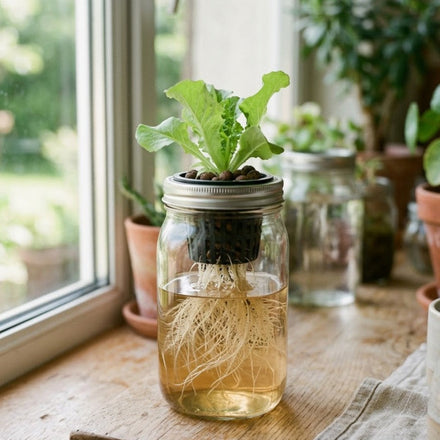
Compared with deep water culture, where the roots sit in a tank aerated by an air stone, NFT moves far less water and lends itself to stacked tiers. On the other hand, it loses the buffering effect that protects a deep tank from a breakdown or a heatwave. The Kratky method, with no pump and no power, takes this logic to the extreme, with a tank that is never refreshed during the crop and roots that follow the falling water level.

The ebb and flow table, or ebb and flow, floods then drains a tray filled with pots or clay pebbles, on the rhythm of a timer. The grow medium retains moisture between two flood cycles, and the table accepts larger plants than the gutters.

NFT remains the right choice when you mainly grow lettuces and herbs, in tight rows, on a light installation that you check every day. The article on the difference between aquaponics and hydroponics places these families of systems in relation to one another.

Conclusion: a film of water and a reliable pump

NFT needs little equipment and no grow medium, but it leaves little margin for error. A slope of 1 to 4%, a continuous trickle that never exceeds 1 to 2 litres per minute per channel, short white channels, pH and EC measured daily, the solution renewed every two weeks and a backup pump are enough to grow lettuce and herbs all year round.

The rest comes down to a habit: checking every morning that water is coming out at the end of each channel.

Sources

FAO, Small-scale aquaponic food production, Fisheries and Aquaculture Technical Paper 589 (Somerville et al., 2014), section 4.4, Nutrient film technique, Maximum flow rate per channel, slope, length, pipe diameters, spacing between plants, filtration in aquaponics, white pipes, and tomatoes and mint that clog.

Oregon State University Extension, EM 9457, Hydro Hints, Nutrient Film Technique (2025), Minimum slope of 2%, suitable crops, temperature sensitivity, fabric bottoms, immediate wilting in the event of a failure.

Virginia Cooperative Extension, SPES-463NP, Hydroponic Production of Edible Crops, Nutrient Film Technique (NFT) Systems (2023), Flow rate of 3 to 5 gallons per hour per channel, length of small systems, backup pump, white tubes, pH and EC for leafy greens.

Neil Mattson, Cornell University, Growing Hydroponic Leafy Greens, GPN (2016), Channels sloped at 1 to 4%, pH and EC for lettuce.

Neil Mattson, Cornell University, Pythium on Hydroponic Basil and Spinach, e-GRO Edible Alert 3-1 (2018), Root zone temperature, dissolved oxygen, symptoms of root rot, disinfection of surfaces.

Oklahoma State University Extension, HLA-6722, Electrical Conductivity and pH Guide for Hydroponics, EC and pH for each crop, a daily reading at a set time, sodium build-up, and a water change every two weeks.

Oklahoma State University Extension, Principles of Small-Scale Aquaponics (Mullins, Nerrie, Sink, Beem), pH and dissolved oxygen in aquaponics, common crops in aquaponics, trellised plants on grow medium.

Nutriculture (Nutrient Systems), NFT Instructions and Grow Guide, Gro-Tank instruction manual, Level installation, root fibre, rockwool at pH 5.5, pH of 5.8 to 6.5, water top-ups, monthly drain-down, heating below 17 °C.


Frequently asked questions

No, not in NFT. The film must flow constantly, since bare roots hold no water reserve, and Oregon State University points out that a halt in circulation can make the plants wilt immediately.

If you would like to water in cycles, that is the principle of an ebb-and-flow table, whose grow medium holds moisture between floods.

It is not essential, but it helps. The film already aerates the roots, and Cornell aims for more than 6 mg/L of dissolved oxygen, preferably 8 to 9 mg/L, a target that is easier to maintain when a small air pump stirs the sump tank, especially in summer.

The flat bottom spreads the film of water better beneath a wide root mat, and it is the profile of commercial growing gutters. A round tube is easy to find in PVC, but the solution concentrates at the low point.

In both cases, allow 7.5 cm in diameter for lettuces and 11 cm for larger plants, as the FAO advises, and choose white, which heats up less in the sun.

Yes, in most cases, as long as you keep an eye on three things.

  • Its calcium content, which points you towards either a soft water or a hard water fertiliser.
  • Its sodium content, which builds up over successive top-ups according to Oklahoma State University, hence the complete renewal of the solution every two weeks.
  • Its starting EC, to be measured before adding the fertiliser so you know what the water already supplies.

This is a sign of a solution that is running out or warming up along the way. Check in this order.

  • The flow rate, which should come out at the foot of the gutter as a continuous stream.
  • The slope, checked with a spirit level at several points, with no dips.
  • The length, to be shortened if the channel exceeds a few metres.
  • The temperature of the solution at the outlet, to be compared with that of the sump tank.

Yes, in the warmer months and out of the strongest sun. Shallow channels follow the air temperature, and the root zone should stay at around 20 to 24 °C according to Cornell. Choose white channels and keep the tank in the shade, and bring the system indoors when the solution drops below 17 °C, the threshold below which Nutriculture recommends heating it.

Read next

Solar aquaponics, a self-sufficient system

Solar aquaponics, a self-sufficient system

The sun can do far more than power a pump: it oxygenates the tank, circulates the water, cooks the fish and dries the herbs from the harvest. Here is how to make a small

Read the article
Protecting your aquaponic system in winter

Protecting your aquaponic system in winter

Winter is a critical period for an aquaponic system: the pond may freeze, bacterial activity collapses and the fish's metabolism slows right down. With the right habits and a minimum of equipment, you can

Read the article
Preparing your aquaponic system for autumn

Preparing your aquaponic system for autumn

Autumn is the season that determines the health of your system throughout winter, as the water cools faster than the aquaponist's habits tend to change. Here is how to manage this transition without stressing

Read the article
Getting started with indoor hydroponics

Getting started with indoor hydroponics

Growing your own salads, herbs and fruit without soil, indoors, all year round and with accelerated growth is no longer the preserve of well-equipped enthusiasts. Indoor hydroponics opens up this possibility to any household,

Read the article
What to grow in hydroponics, season by season

What to grow in hydroponics, season by season

Hydroponics is not entirely independent of the seasons. While soilless cultivation allows you to extend harvests and grow indoors all year round, light, temperature, and day length continue to influence the rhythm of your

Read the article
Kratky Method : Passive Hydroponics Without a Pump

Kratky Method : Passive Hydroponics Without a Pump

Pump-free, electricity-free, and intervention-free hydroponics, that's the astonishing promise of the Kratky method. A minimalist approach based on a simple physical principle that opens up soilless cultivation to all gardeners, from curious beginners to

Read the article

Discover our aquaponics greenhouses and kits:

View all
Produits du rayon Kits d'aquaponie chez Univers Aquaponie

Aquaponics kits

Aquaponics kits ready to install in the garden, on a patio or in a greenhouse, with fish tank, grow beds and pump.

Discover
Produits du rayon Univers Plantes chez Univers Aquaponie

Plants

Seeds, grow media, fertilisers and aquatic plants for successful growing in aquaponics, hydroponics and the vegetable garden.

Discover
Produits du rayon Univers Équipements chez Univers Aquaponie

Equipment Universe

The equipment that keeps a system running: soilless growing, water circulation and aeration, filtration, temperature, plumbing and lighting.

Discover
Produits du rayon Serres d'aquaponie chez Univers Aquaponie

Aquaponics greenhouses

Greenhouses designed for aquaponics, supplied with their fish tank and grow towers.

Discover
Produits du rayon Univers Poissons chez Univers Aquaponie

Fish

Feed, monitor the water and care for your pond, aquarium or aquaponic fish.

Discover
Produits du rayon Univers Formation chez Univers Aquaponie

Learning

Books and practical courses on aquaponics, hydroponics and food self-sufficiency.

Discover