



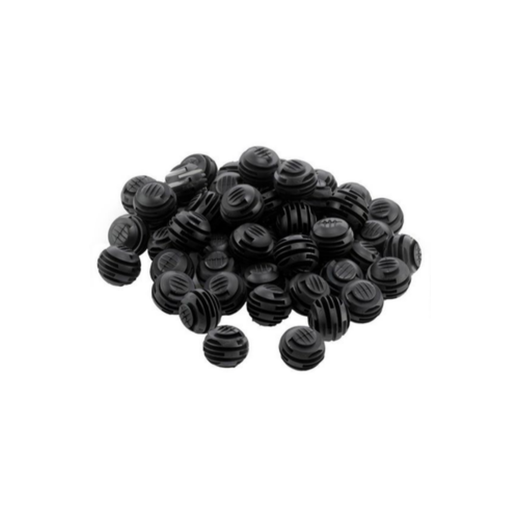


EHEIM SUBSTRATpro biological filtration beads
Regular price
$11.24
Regular price
Sale price
$11.24
Unit price
/
per
These sintered quartz beads fill the biological stage of the filter, between the mechanical pre-filtration and the carbon. One litre provides 450 m² of surface area for the nitrifying colony, and the media is rinsed in tank water and never needs replacing.
 Customer support 7 days a week by email
 Delivery within 2 to 15 business days
100 % secure payment
The summary
- What you receive: EHEIM SUBSTRATpro sintered quartz beads, in 250 ml, 1, 2 or 5 litre sizes.
- What they provide: 450 m² of colonisation surface per litre of media.
- Where they go: in the middle of the filter, after the mechanical pre-filtration.
- How to maintain them: a rinse in tank water, basket by basket, never all at once.
A biological mass that houses the nitrifying colony of your filter
EHEIM SUBSTRATpro biological filtration beads are made of sintered quartz and house the colony of nitrifying bacteria that converts ammonia into nitrite and then into nitrate. One litre offers 450 m² of colonisation surface. They are placed after the mechanical pre-filtration, in freshwater and seawater alike, and are simply rinsed, never replaced.
The bacteria that convert ammonia into nitrite, then nitrite into nitrate, do not live in suspension in the water: they attach themselves to the surfaces that the flow passes over. The biological stage of a filter therefore serves to give them colonisation surface supplied with oxygenated water, and the EHEIM SUBSTRATpro sintered quartz beads fulfil this role, in freshwater and in seawater alike.
📐 450 m² of surface area per litre
One litre of these beads provides 450 m² of colonisation surface for a weight of about 720 g. The quartz is sintered, that is, heated until its grains fuse together, leaving a network of open pores, so that most of this surface lies inside the beads. The spherical shape plays a second role: the beads flow until they fill the whole volume of the basket you set aside for them, while leaving regular channels between them for the water.
Reusable
The beads are rinsed and then go back in the basket: they do not wear out like a consumable.
A mass to protect from mud
A mass clogged with mud is no longer irrigated, whatever its surface area, and pre-filtration upstream protects it.
🦠 Cleaning without losing the colony
Never clean or replace all of your biological media at once. The bacterial colony takes several weeks to establish itself on new media, and if you remove it in one go, ammonia and nitrite are no longer converted: their levels then rise in the fish's water just as they do during a first start-up. Work basket by basket on an external filter, or module by module on an internal filter, so that the part left in place reseeds the part you have rinsed. The article on the nitrogen cycle in aquaponics describes each of these conversions in detail.
No tap water on the biological media
Never put this media under the tap, because the chlorine in mains water destroys the attached bacteria, and the filter then loses for several weeks its ability to convert ammonia and nitrite, whose levels rise in the tank. Rinse it in a bucket of water taken from the tank during the water change. To expand your filtration, add the new media alongside the old rather than replacing it, because the old media seeds the new within a few weeks.
Ceramic pre-filtration in front of the beads
The beads only keep their useful surface area if the water reaching them has already been cleared of larger particles. The EHEIM MECH ceramic pre-filtration noodles therefore go in the first basket, the one the water passes through as it enters the filter. This spaces out the rinses of the biological media, and the colony is disturbed less often.
🥬 The biological stage in aquaponics
In aquaponics, this stage provides a large share of the nitrate that the plants take up: the ammonia released by the fish is oxidised here to nitrite, then to nitrate, the form of nitrogen that crops absorb most readily. An undersized biofilter shows up first in the fish water, where nitrite remains measurable after feeding, while the plants show only a slowing of growth. So allow a generous volume of media when your tank is heavily stocked, and follow the guide to getting an aquaponic system off to a good start before adding the first fish.
📦 Choosing your size
The 250 ml size matches the biological media module of the EHEIM aquaball internal filters, which you can fill without splitting a bag. The 1 and 2 litre sizes fill one or two external filter baskets, while the 5 litre bucket is for large filters or for equipping several tanks. The right quantity is measured on the free volume of the biological basket, once the pre-filtration is in place: fill this basket with water, pour it into a measuring jug, and you can read off the volume of beads to allow for.
Technical specifications
The essentials
- Material
- Spherical sintered quartzHeated until the grains fuse together, which opens up a network of pores.
- Colonisation surface
- 450 m² per litreIt is the surface area available to the nitrifying colony.
- Density
- About 720 g per litreKitchen scales are enough to portion out a bag.
- Space in the filter
- After the mechanical pre-filtrationBefore the activated carbon, if you use one.
- Maintenance
- Rinsing in tank waterNever straight from the tap, and never all of it at once.
- Water type
- Freshwater and saltwater
To budget for separately
- Mechanical pre-filtration
- Ceramic noodlesWhat is not stopped at the inlet ends up clogging the beads.
- Rinsing bucket
- A bucket kept only for the tankFilled with tank water at the time of the water change.
In the box
- 1 box or 1 bucket of loose sintered quartz beads, from 250 ml to 5 L depending on the size chosen
Material, colonisation surface, bulk density and maintenance instructions taken from the manufacturer's data, on 11/10/2026.
Manufacturer and product safety
- Manufacturer
- EHEIM GmbH & Co. KG
- Postal address
- Plochinger Str. 54, 73779 Deizisau, Allemagne
- Contact
- info@eheim.com
- Website
- eheim.com
Information provided under Regulation (EU) 2023/988 on general product safety.
Which filter media for which basket?
Three media sold in the same volumes, which do not occupy the same level of the filter.
A filter is packed in a set order, not just tipped in loose
What stops the particles comes first, what houses the bacteria comes next, and what removes the molecules comes last.
| Filter stage | What it treats | Bacterial colony carrier | Acts on colour and odour | Routine maintenance | Replace after | To be removed during treatment | Price | |
|---|---|---|---|---|---|---|---|---|
| EHEIM MECH ceramic pre-filtration noodlesYour choice | First, at the water inlet | The larger particles | Yes | No | Rinse it, tap water is fine | Never | No | $12.37 |
| Recommended EHEIM SUBSTRATpro biological filtrationYour choice | Second, after the mechanical stage | It houses the bacteria | Yes | No | Rinse it in tank water | Never | No | $11.24 |
| EHEIM Karbon activated carbon forYour choice | Last, after the biological stage | Dissolved molecules | No | Yes | Replaceable | 4 weeks | Yes | $11.24 |
EHEIM MECH ceramic pre-filtration noodles
Space in the filter
Filter stageFirst, at the water inlet
What it treatsThe larger particles
What the media provides
Bacterial colony carrierYes
Acts on colour and odourNo
Maintenance
Routine maintenanceRinse it, tap water is fine
Replace afterNever
To be removed during treatmentNo
EHEIM SUBSTRATpro biological filtrationRecommended
Space in the filter
Filter stageSecond, after the mechanical stage
What it treatsIt houses the bacteria
What the media provides
Bacterial colony carrierYes
Acts on colour and odourNo
Maintenance
Routine maintenanceRinse it in tank water
Replace afterNever
To be removed during treatmentNo
EHEIM Karbon activated carbon for
Space in the filter
Filter stageLast, after the biological stage
What it treatsDissolved molecules
What the media provides
Bacterial colony carrierNo
Acts on colour and odourYes
Maintenance
Routine maintenanceReplaceable
Replace after4 weeks
To be removed during treatmentYes
Manufacturer's values taken on 11/10/2026, including the colonisation surface area of the beads, 450 m² per litre.
Help choosing
What weight for which basket?
Estimate your
delivery time
Your estimate
Delivery
Estimated time
It covers preparing your order and then the transit time quoted by the carrier, counted in working days.
It is not a guaranteed delivery date: public holidays, peak periods, customs or a carrier delay can extend it. The exact amount, in your currency, is worked out in the cart once your address is entered.
Lightweight parcel, dispatched within 48 hours by Colissimo or Chronopost to your home, as you choose at payment. The exact cost depends on the method selected.
Frequently asked questions
6 questions
6 key questions
You may also like


Related articles

Understanding
The nitrogen cycle in aquaponics
Where nitrate is produced, and why a colony takes weeks to establish itself.
Read the article

Guide
Getting started with an aquaponic system
The order for starting up a circuit, and when to add the first fish.
Read the article

Troubleshooting
Understanding and clearing cloudy water
What cloudy, milky water tells you about the biological stage and its load.
Read the article

Getting started
Common mistakes in aquaponics
Rinsing under the tap tops the list of things that wreck a filter.
Read the article

Species
Koi carp in aquaponics
A species that loads the water quickly and needs a large biological stage.
Read the article
Let us talk about your project
A question about this product or your setup? Our team will answer and advise you.

Interest-free instalment payments
Offered depending on the cart amount, at checkout.

Delivery in 2 to 15 working days
Depending on the products and shipping sites. Estimate by destination in the estimator on this page.

After-sales service 7 days a week by email or chat
Our team answers all your questions.

Shop responsibly
Become part of the change.
