

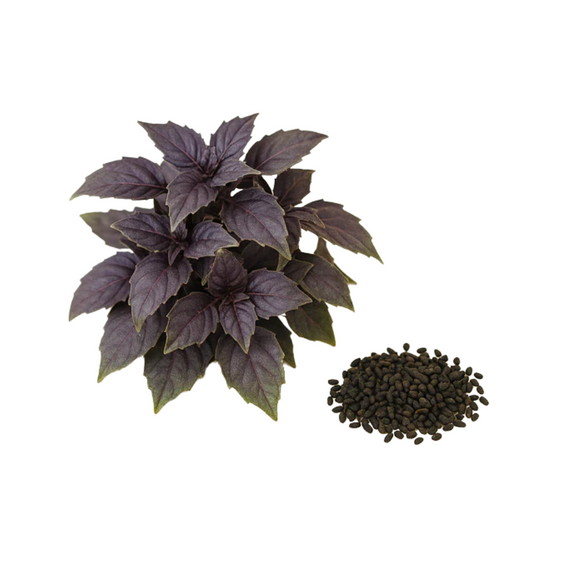
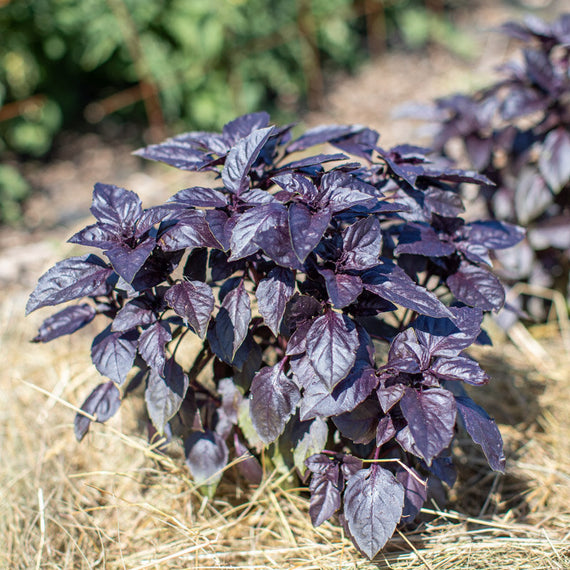
Basil seeds, Dark Opal
Regular price
$4.45
Regular price
Sale price
$4.45
Unit price
/
per
An ornamental basil with broad pointed leaves, Dark Opal shifts from glossy purple to dark green depending on the light and bears mauve flowers, for plates and vinegars.
The packet contains 200 seeds, organic and open-pollinated. Sowing is done under cover from March to June, on the surface, at 18 to 20 °C, and harvesting runs from June to October.
 Customer support 7 days a week by email
 Delivery within 2 to 15 business days
100 % secure payment
The summary
- What you receive: 200 organic, open-pollinated Dark Opal basil seeds.
- Sowing: under cover from March to June, on the surface, at 18 to 20 °C.
- The foliage: large pointed leaves, from bright purple to dark green, with mauve flowers.
- What matters most: light, which governs the intensity of the colour.
- Harvest: from June to October, on a clump 20 to 30 cm tall.
- How to choose: this one for colour, Genovese for pesto.
Basil with glossy purple foliage, 200 farm-saved seeds, for plates and vinegars
Dark Opal basil seeds, from the Kokopelli association, grow into a decorative basil with broad, pointed leaves, from glossy purple to dark green, with mauve flowers. The packet contains 200 organic, open-pollinated seeds. The colour depends on the light: it is deepest on well-exposed plants. The clump reaches 20 to 30 cm.
Dark Opal is an ornamental basil that was bred in the United States in the 1950s. Its large, pointed leaves vary in colour from plant to plant, from glossy purple to dark green, and its flowers are mauve. You can use it as much for its looks as for its fragrance, as whole leaves on a plate or infused in a vinegar.
💜 A colour that follows the light
The purple colour comes from pigments, the anthocyanins, which the leaf produces in greater quantity the more light it receives. The variety tolerates partial shade, but it is on well-exposed plants that the colour is deepest and most even. Indoors, supplementary lighting therefore matters more to the appearance of your harvest than the richness of the grow medium. The guide to getting started with indoor hydroponics explains how to choose and set the lighting for a crop of herbs.
In full sun
The purple is deep and uniform, on the leaf as on the stem.
Semi-shade
Some of the leaves keep a dark green tint, mixed with purple.
Indoors
A grow light makes up for the light from a poorly exposed window.
Raise the purple seedlings under a lamp
If you sow in late winter in a poorly lit room, the LED-lit seedling mini-greenhouses supply the light that young plants lack. Each dome has its own lamp, adjustable from 4 to 18 hours a day, which stops the seedlings from stretching towards the window. Your basil plants then reach transplanting with short stems and foliage that is already well coloured.
🌱 From seedling to planting out
Sowing takes place under cover from March to June, about 6 weeks before planting out. Place the seeds on the surface in a tray, press them down with your finger without covering them, and keep the medium between 18 and 20 °C in a well-lit sheltered spot. At the 4 to 5 leaf stage, prick out into individual pots. Planting out then follows in well-warmed soil, 25 to 30 cm apart, for a clump that reaches 20 to 30 cm. Water sparingly, as an overly damp medium encourages leggy seedlings.
Once transplanted, Dark Opal fits just as well into an aquaponic system, where it is grown like a green basil: its nitrogen needs are modest, its roots stay short and it tolerates a system that is still young, in a bed filled with clay pebbles or in a tower. The difference lies in the light, which here governs the colour of the leaves as well as vigour. Place it in the brightest spot you have, at the top of a tower or along the south edge of a bed. The guide to the 15 plants to grow in aquaponics lists basil among the herbs that do best there, noting its high light requirement.
✂️ Pinch out for coloured leaves
Weekly pinching out, just above a pair of leaves, doubles the number of stems and delays the purple flowering. On this variety, it has an added benefit: the young leaves at the top are the best coloured, and a plant that you force to branch produces them all summer. Harvesting runs from June to October. In the kitchen, the colour keeps better raw, on a plate or in a vinegar that it tints, than with fierce cooking. If you are mainly after a basil for pesto, Genovese Green is sown at the same time.
Technical specifications
The sachet
- Number of seeds
- 200Enough to sow in succession over several seasons.
- Seed origin
- Kokopelli associationOrganic seeds, royalty-free.
- Seed type
- Open-pollinated, non-hybridReproducible: seed from your own harvest will give the same variety.
- Seed storage
- Around 8 yearsStore in a dry, cool, dark place.
The variety
- Botanical name
- Ocimum basilicum
- Foliage
- Glossy purple to dark greenThe colour is at its richest in full light.
- Leaf and flower
- Broad and pointed, mauve flowers
- Adult height
- 20 to 30 cm
Seedling and harvest
- Seedlings under cover
- March to JuneIn a tray, 6 weeks before planting out.
- Seedling depth
- On the surfacePress the seed down with a finger, without covering it.
- Seedling temperature
- 18 to 20 °C
- Transplanting
- At the 4 to 5 leaf stage
- Spacing
- 25 to 30 cmBetween two plants, in a pot or a trough.
- Harvest period
- June to October
To budget for separately
- Indoor light
- A lit mini greenhouse or a lamp
- Seedling medium
- Foam pods or fine compost
8 further specifications are available in the detailed view.
In the box
- 1 paper packet of 200 Dark Opal basil seeds, harvested from organic farming
- 1 variety label: botanical name, sowing period, and year of seed harvest
Variety sheet from the seed supplier Kokopelli (contents, sowing, harvest, sizes), checked on 11/10/2026; the number of seeds may vary from one batch to another. Temperatures, germination times and storage periods are approximate figures for mainland France.
Manufacturer and product safety
- Manufacturer
- Association Kokopelli (SIREN 433481124, TVA FR80433481124)
- Postal address
- 7 route de Sabarat, Forêt de Castagnès, 09290 Le Mas-d'Azil, France
- Contact
- Formulaire de contact : https://kokopelli-semences.fr/fr/faq/ (aucune adresse e-mail publique) ; téléphone 05 61 67 69 87
- Website
- kokopelli-semences.fr
Information provided under Regulation (EU) 2023/988 on general product safety.
Dark Opal or Vert de Gênes
Two farmers' basils in packets of 200 seeds, which are sown at the same time and at the same temperature. Colour, leaf and use in the kitchen set them apart.
A coloured basil and a green basil
Both are sown in the same way. The choice comes down to the plate and the space, not to difficulty.
| Foliage colour | Leaf shape | Flower colour | Primary use | Maximum adult height (cm) | Seedlings under cover | Seedling temperature | Seeds per packet | |
|---|---|---|---|---|---|---|---|---|
| Genovese basil seedsYour choice | Bright green | Very wide, domed like a spoon | White | Pesto and sauces | 40 cm | March to June | 18 to 20 °C | 200 |
| Recommended Basil seeds, Dark OpalYour choice | Glossy purple to dark green | Broad and pointed | Mallows | Plate garnish and vinegars | 30 cm | March to June | 18 to 20 °C | 200 |
Genovese basil seeds
The plant
Foliage colourBright green
Leaf shapeVery wide, domed like a spoon
Flower colourWhite
Primary usePesto and sauces
Maximum adult height (cm)40 cm
The seedling
Seedlings under coverMarch to June
Seedling temperature18 to 20 °C
Seeds per packet200
Basil seeds, Dark OpalRecommended
The plant
Foliage colourGlossy purple to dark green
Leaf shapeBroad and pointed
Flower colourMallows
Primary usePlate garnish and vinegars
Maximum adult height (cm)30 cm
The seedling
Seedlings under coverMarch to June
Seedling temperature18 to 20 °C
Seeds per packet200
Variety sheets from the seed supplier Kokopelli, consulted on 11/10/2026.
Help choosing
Which basil for your growing corner
Estimate your
delivery time
Your estimate
Delivery
Estimated time
It covers preparing your order and then the transit time quoted by the carrier, counted in working days.
It is not a guaranteed delivery date: public holidays, peak periods, customs or a carrier delay can extend it. The exact amount, in your currency, is worked out in the cart once your address is entered.
A packet of seeds ships as a small parcel. It can be grouped at no extra cost with the rest of your order, and the exact amount is calculated at checkout.
Frequently asked questions
6 questions
6 key questions
Growing calendar
Guidelines for mainland France, to be shifted by about 2 weeks depending on your region.
| Stage | ||||||||||||
|---|---|---|---|---|---|---|---|---|---|---|---|---|
| Seedlings under cover4 months | Seedlings under cover: no | Seedlings under cover: no | Seedlings under cover in March | Seedlings under cover in April | Seedlings under cover in May | Seedlings under cover in June | Seedlings under cover: no | Seedlings under cover: no | Seedlings under cover: no | Seedlings under cover: no | Seedlings under cover: no | Seedlings under cover: no |
| Installation3 months | Installation: no | Installation: no | Installation: no | Installation: no | Installation in May | Installation in June | Installation in July | Installation: no | Installation: no | Installation: no | Installation: no | Installation: no |
| Weekly pinching out4 months | Weekly pinching out: no | Weekly pinching out: no | Weekly pinching out: no | Weekly pinching out: no | Weekly pinching out: no | Weekly pinching out in June | Weekly pinching out in July | Weekly pinching out in August | Weekly pinching out in September | Weekly pinching out: no | Weekly pinching out: no | Weekly pinching out: no |
| Harvest5 months | Harvest: no | Harvest: no | Harvest: no | Harvest: no | Harvest: no | Harvest in June | Harvest in July | Harvest in August | Harvest in September | Harvest in October | Harvest: no | Harvest: no |
KeySeedlings under coverInstallationWeekly pinching outHarvest
This month
November
Growing guidance
- Seedling depth
- On the surfaceSeed pressed in with a finger, left uncovered
- Seedling temperature
- 18 to 20 °C
- Seedling before planting out
- 6 weeks
- Spacing
- 25 to 30 cmBetween two plants, in a pot or a trough
- Adult height
- 20 to 30 cm
- Foliage
- Glossy purple to dark greenThe shade follows the light received
- Aspect
- Sun to partial shadeMore light, more purple
- Cycle
- Annual, frost-tender
- pH in aquaponics
- 6.5 to 7.5The usual balance between fish, bacteria and plants
- Seed storage
- Around 8 yearsDry and away from light
What you need to know
- Colour is built with light. A plant placed in full sun turns deep purple, whereas the same one in partial shade keeps some of its leaves dark green.
- Lay the seed on the surface and press it down with your finger, without covering it with compost: like other basils, it germinates poorly when buried.
- Pinch above a pair of leaves every week. On this variety, each cut does double duty: it multiplies the stems and encourages young leaves, which have the best colour.
- Water at the base and in the morning. Leaf spots show up far more clearly on purple foliage than on green, and they start from evening watering that wets the leaves.
- Prefer gentle cooking to fierce heat. The colour holds better in a dish added at the end of cooking or in a vinegar than in a scorching pan, where it turns brown.
- In aquaponics, its needs are those of an ordinary basil, with short roots and a young system tolerated. Light also becomes a colour criterion, hence the value of giving it the brightest spot.
You may also like



Related articles

Guide
Getting started with indoor hydroponics
Growing indoors, without a garden: light, space, watering, and what it really demands each week.
Read the article

Selection
The 15 plants to grow in aquaponics
A ranking of crops by nitrogen appetite, and which ones thrive on a young system.
Read the article

Troubleshooting
Germination failure: causes and solutions
Seeds that fail to germinate, patchy germination, leggy seedlings: the six real causes and how to correct them.
Read the article

Equipment
Setting up an indoor seedling space
Heat mat, lighting, humidity: setting up a reliable propagation corner at home and making it pay.
Read the article

Cooking
Summer recipes from the kitchen garden
What to do with a glut harvest, without throwing anything away or freezing half of it.
Read the article

Schedule
What to grow in hydroponics, season by season
What to sow in January, April and September to keep a grow bed in constant production.
Read the article
Let us talk about your project
A question about this product or your setup? Our team will answer and advise you.

Interest-free instalment payments
Offered depending on the cart amount, at checkout.

Delivery in 2 to 15 working days
Depending on the products and shipping sites. Estimate by destination in the estimator on this page.

After-sales service 7 days a week by email or chat
Our team answers all your questions.

Shop responsibly
Become part of the change.
