



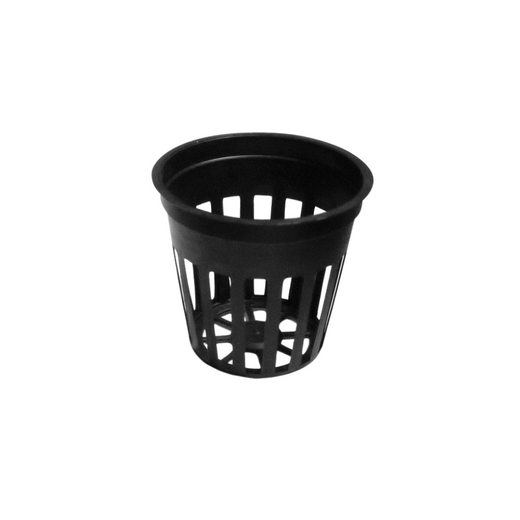


Aquaponic grow bed, 45 to 80 litres
Regular price
$28.40
Regular price
Sale price
$28.40
Unit price
/
per
| Size | Price | Price per L | vs 80 L |
|---|---|---|---|
| 45 L | $28.40 | $0.63 | −15 % |
| 55 L | $36.38 | $0.66 | −11 % |
| 60 L | $42.08 | $0.70 | −5 % |
| 80 L | $59.19 | $0.74 | — |
This grow bed in black high-density polyethylene comes in 45, 55, 60 and 80 L. It takes a grow medium of clay pebbles for growing vegetables, fruit and herbs in aquaponics, and its two reinforced handles make it easier to move when empty or lightly loaded.
 Customer support 7 days a week by email
 Delivery within 2 to 15 business days
100 % secure payment
The summary
- The volumes: 45, 55, 60 or 80 L, for 6 to 16 plants depending on the size chosen.
- The material: black high-density polyethylene, resistant to impacts, UV and nutrient solutions.
- What helps day to day: two reinforced handles and a graduation moulded into the wall.
- What goes in it: clay pebbles of 8 to 20 mm, then seedlings or young plants.
Black HDPE tank, graduated and fitted with handles, for growing on clay pebbles.
The black HDPE aquaponic grow bed is available in 45, 55, 60 and 80 L, for 6 to 16 plants depending on the size. It takes a grow medium of clay pebbles of 8 to 20 mm. Its opaque polyethylene blocks light, which limits algae, and it withstands impacts, UV and nutrient solutions.
This rectangular tub in high-density polyethylene is the basic unit of a grow medium system. It comes in four capacities, from 45 to 80 L, with thick walls that cope with the weight of waterlogged clay pebbles, two reinforced handles for moving it, and a moulded graduation that saves you from guessing the water level.
⚫ Black against algae
The colour has a purpose, since it stops light reaching the roots and the water. A translucent tank lets through enough light for algae to settle in the grow medium, turn the base of the plants green and compete with your crops for nutrients. A black, opaque wall blocks that light, so you have no film or cover to fit. HDPE, for its part, withstands knocks, ultraviolet light and prolonged contact with a nutrient solution without weakening, which makes it a container for several seasons rather than just one.
💧 Its place in a circuit
In aquaponics, this tank carries both the crops and a large part of the filtration, because the clay pebbles hold the roots and also house the bacteria that turn fish waste into nitrates. Fill it with 8 to 20 mm clay pebbles, plant, then connect it to your circuit. Aim for a pH between 6.4 and 7.5 and water between 18 and 26 °C, and the guide on choosing a grow medium covers the rest.
45 L
The format for lettuces, herbs and seedlings, whose roots stay near the surface.
55 and 60 L
The all-purpose size, which takes a batch of lettuces just as well as a strawberry plant.
80 L
The volume for fruiting plants such as tomato, cucumber or pepper, whose roots seek out depth.
Filling the tray with a 50 L bag of clay pebbles
The 50 L bag of 8 to 20 mm clay pebbles fills the 45 L or the 55 L tray on its own, leaving a few centimetres of clearance at the top; if you choose the 60 L or the 80 L, plan for a second bag. This size lets water circulate between the pebbles without clogging, while giving bacteria a large surface to settle on. Rinse the pebbles before pouring them in, so that their dust does not cloud the fish water.
Allow 1 kg per litre of support
An 80 L tray filled with water-soaked clay pebbles can weigh nearly 80 kg, and it is this mass that determines the load-bearing structure. The handles are for moving an empty or barely damp tray, never one with a crop in it. If you place the tray on a table or shelf, size it before filling, on a basis of 1 kg per litre of volume, and support the tray across its whole base rather than on two cross-members, because a plastic base flexes and eventually cracks at the point of overhang.
📐 Choosing the volume
A grow bed is chosen first according to what you intend to grow in it. Salads and herbs are happy with the 45 L, whose 19 cm depth is enough for roots that stay near the surface, whereas a tomato or strawberry plant will be far more comfortable in the 60 or 80 L, which are 29 and 31 cm deep. This depth matters in aquaponics, where a bed of about 30 cm of pebbles separates a dry layer at the surface, a root zone and a base where bacteria and solid waste concentrate. If in doubt, take the next size up, since the roots of fruiting vegetables quickly fill all the available space. The guide to soilless growing explains the role of an inert grow medium such as clay pebbles.
🔩 Drilling and fitting
HDPE can be drilled with a hole saw or a punch, at low speed and without forcing it, as the material melts if the tool gets hot. Always drill on a flat wall, never in a corner radius or a rib, and keep at least 2 cm between the edge of your hole and the corner of the tray. The fitting is then made with a flat-gasket bulkhead connector tightened by hand, as an O-ring will not hold on a flexible wall that deforms. Finally, test for watertightness with clean water, with the tray standing on a dry floor, before you pour in a single litre of clay pebbles, because a seal is hard to redo once the tray is loaded with 60 kg of grow medium.
Technical specifications
The essentials
- Material
- High-density polyethyleneRecyclable, resistant to impacts, UV and nutrient solutions.
- Colour
- BlackBlack deprives algae of the light they need.
- Shape
- Rectangular, flat-bottomedThe flat bottom spreads the grow medium evenly without leaving dry patches.
- Handles
- 2, reinforced
- Graduation
- Moulded into the wallTo monitor the water level without a probe or any added marker.
- Recommended grow medium
- Clay pebbles 8 to 20 mmA coarse grade lets water flow through without clogging the bed.
The four volumes
- 45 L
- 6 to 8 plantsOpening 70 × 40 cm, height 19 cm, 1.17 kg empty.
- 55 L
- 8 to 10 plantsOpening 66 × 45 cm, height 28 cm, 2.07 kg empty.
- 60 L
- Up to 12 plantsOpening 73 × 40 cm, height 29 cm, 1.64 kg empty.
- 80 L
- 12 to 16 plantsOpening 78 × 54 cm, height 31 cm, 2.26 kg empty.
2 further specifications are available in the detailed view.
In the box
- 1 grow bed of 45, 55, 60 or 80 L, depending on the volume chosen
Material, colour, volumes and planting capacities: product data sheet, consulted on 20/09/2026. Dimensions and empty weights: product images, consulted on 11/10/2026. 30 cm bed: FAO aquaponics manual.
Estimate your
delivery time
Your estimate
Delivery
Estimated time
It covers preparing your order and then the transit time quoted by the carrier, counted in working days.
It is not a guaranteed delivery date: public holidays, peak periods, customs or a carrier delay can extend it. The exact amount, in your currency, is worked out in the cart once your address is entered.
The trays travel empty and nested together when several are ordered, which keeps the parcel compact.
Frequently asked questions
8 questions
6 key questions, 8 in the detailed view
You may also like


Related articles

Grow medium
Which grow medium to choose for aquaponics?
Clay pebbles, gravel or pozzolana: how each medium holds up and how to maintain it.
Read the article

Assembly

Water
Regulating pH in an aquaponics system
Keeping the pH stable without a generic chemical product.
Read the article
Growing
The 15 plants to grow in aquaponics
The plants that succeed in aquaponics, and those that need a deep bed.
Read the article

Understanding
Soilless growing in hydroponics
The role of an inert grow medium in soilless growing.
Read the article

Diagnosis
Understanding and correcting cloudy water in aquaponics
What light on the grow medium triggers.
Read the article
Let us talk about your project
A question about this product or your setup? Our team will answer and advise you.

Interest-free instalment payments
Offered depending on the cart amount, at checkout.

Delivery in 2 to 15 working days
Depending on the products and shipping sites. Estimate by destination in the estimator on this page.

After-sales service 7 days a week by email or chat
Our team answers all your questions.

Shop responsibly
Become part of the change.
