



Hydroponic pack for 20 plants: system, grow medium and nutrients
Regular price
$915.13
Regular price
$967.07
Sale price
$915.13
Unit price
/
per
$305.04 × 3 with no fees
Klarna.
This pack brings together the Terra Aquatica 20-plant gutter system and everything you need to start your first crop: TriPart nutrients in 3 one-litre bottles, the clay pebbles that fill the baskets, the powdered pH adjuster and the pH test.
The system is built around a 150-litre usable reservoir, which gives you time to correct the solution.
 Customer support 7 days a week by email
 Delivery within 2 to 15 business days
100 % secure payment
The summary
- What you receive: the complete 20-plant channel system, TriPart Grow, Micro and Bloom in 1 L each, a bag of clay pebbles, the pH- adjuster in powder form and a pH test.
- What you do with it: 20 plants grown side by side on a single reservoir, without having to choose each consumable yourself or place three separate orders.
- What it consumes: a 16 W pump, the only appliance in the system, which means 0.29 to 0.38 kWh per day.
- How long it lasts: the 3 L of nutrients cover a first full cycle on 20 plants, not an entire season.
- How to choose: it is the largest of the three growing packs, the one that holds the most water in reserve.
- How it arrives: four parcels, about 33 kg in total, including two long 109 cm parcels that must be received at home.
20-plant channel system, clay pebbles, TriPart nutrition and pH control
To start a crop, a hydroponic system needs a complete nutrient solution, something to hold 20 plants in their baskets, and the means to measure and then adjust the pH. This pack covers all of that, with products from the same brand as the system, and saves you from putting the list together yourself.
💦 Circulation in the gutters
A single pump handles all the circulation. It draws the solution from the reservoir, with 150 litres of usable volume, and sends it to the head of the four one-metre channels, where it trickles over the roots before returning to the reservoir by gravity. A level pipe keeps a shallow film of solution at the bottom of each channel, and the surplus falls back into the reservoir. This aero-hydroponic principle places the roots in the humidity-saturated air of the channels, above a continuously stirred solution, without the fine misting of high-pressure aeroponics. The pump supplied is a Sicce Syncra Silent 1.0 of 16 W, adjustable up to 950 litres per hour, with a head height of 1.5 metres, more than enough here. The channels have a white double-wall profile, about 18 x 14.7 cm with the lid, which reflects light and keeps the roots in darkness, whereas a translucent channel is enough for algae to take hold within a few weeks. The lid of a channel lifts off so you can check the state of the roots, which stay white as long as the solution is well oxygenated and turn brown when it is too warm or circulation has stopped.
The system
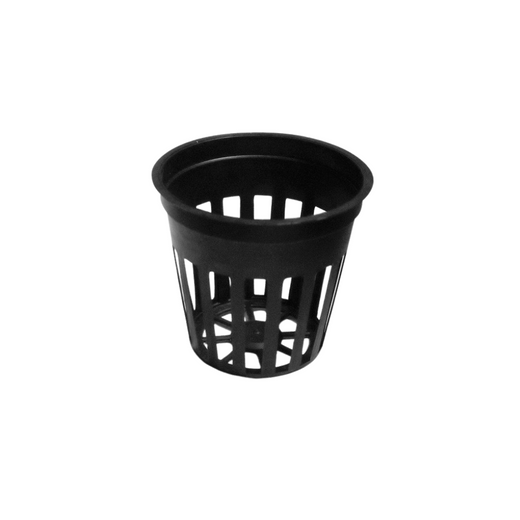
Four one-metre channels, a 150 L usable reservoir, a Sicce Syncra Silent 1.0 pump, 20 baskets of 8 cm, a drain kit and a brush.
Nutrition
TriPart Grow, Micro freshwater and Bloom, 1 L each, enough to run a first complete cycle on 20 plants.
The grow medium
10 litres of clay pebbles of 8 to 20 mm. The 20 net pots of 8 cm need about 6 litres.
pH
The powdered pH- corrector, 250 g of urea phosphate, and a colorimetric drop test to read the value.
🧪 Three concentrates, one cycle
The TriPart range splits nutrition into three. Micro, with an NPK of 5-0-1, supplies calcium, iron and trace elements, and it stays in the mix from seedling to harvest. Grow, at 3-1-6, provides the nitrogen and potassium for growth. Bloom, at 0-5-4, provides the phosphorus and potassium for flowering, with 3% magnesium and 5% sulphur. You change the proportions through the cycle instead of changing product: it is a little more work at the start and much more control afterwards. The order of mixing matters: Micro first in the water, then Grow, then Bloom, never one concentrate poured into another. The Micro supplied is the soft water version, formulated for water low in calcium and magnesium; on very hard water, its dose is slightly reduced, otherwise the starting conductivity is already too high before the plants have absorbed anything.
Empty slots and algae
Do not let light into a partially filled channel: block the empty slots with their baskets filled with clay pebbles, otherwise algae will take hold within 3 weeks. Never pour the dry pH- corrector into the reservoir: dissolve it first to make a correction solution. And wear goggles when dosing the Micro: it is the only one of the three bottles classed as Danger, H318, as it causes serious eye damage.
Switch the pump off at night with a timer
A daily timer plugged in between the socket and the pump cuts the circulation at the times you choose, generally at night, when the plants transpire little and the film of water retained at the bottom of the channels keeps the roots moist. Switched off for 6 hours each night, the pump uses 0.29 kWh per day instead of 0.38. However, keep it running continuously for the first few weeks, while you check the condition of the roots, and in hot weather, when circulation maintains the oxygenation of the solution.
🧮 Doses throughout the cycle
Doses are given per litre of solution, to be multiplied by the volume you are preparing. In full growth and in hydroponics, allow 1.8 ml of Grow, 1.2 ml of Micro and 0.6 ml of Bloom per litre. In flowering, the ratio is reversed, with Bloom rising to 2.4 ml and Micro to 1.6 ml. Aim for a conductivity of 1.3 to 1.8 mS in full growth, and a pH of 5.5 to 6.5. Adjust the pH last, once all three parts have been added, because each one changes the value. In 150 litres, a correction takes around forty minutes to spread through the solution despite the constant circulation, and the check reading should be taken after that delay rather than straight after pouring. Our article on pH regulation covers measuring and correcting in detail.
🎨 Reading the pH from the drops
The test supplied is colorimetric: a few drops of reagent in a sample, then you compare the colour against the chart. The 60 ml bottle comfortably covers a season of frequent measurements, and it needs no calibration, no buffer solution and no battery. Two conditions are needed for the reading to be worth anything: daylight and a white background, because pink horticultural lighting makes the comparison impossible. In practice you read to the half point, not the tenth, which is more than enough to hold a range. Always sample from the same spot in the reservoir and after mixing, as a sample taken just after an addition does not represent the whole reservoir. Store the bottle away from light, as colorimetric reagents lose accuracy once exposed to sunlight for long periods.
🧂 The pH adjuster
The pH-lowering product supplied is 100% urea phosphate, a powder that is inert when dry and turns acidic once dissolved. Dissolve it at 1 g per 5 to 6 litres of water, then add this correction solution in small amounts, measuring after each addition, as the total quantity depends on the hardness of your water. This salt is made of urea and phosphoric acid, so it adds phosphorus and nitrogen to the solution as well as lowering the pH. At a typical correction dose the contribution is marginal, but it explains why very hard water that needs a lot of pH down ends up more heavily loaded than expected. The 250 g supplied cover several complete refills of the tank with water of average hardness. Store the powder dry and sealed, as it absorbs moisture from the air and eventually cakes into a block that is difficult to dose.
🚰 The first cycle, step by step
Assemble the system dry following the instructions, then fill with clean water and run it for an hour: you are checking for leaks and, above all, that the flow is equal across the four channels. Rinse the clay pebbles, fill the baskets, prepare the solution, adjust the pH, and transplant plants that are already rooted. After that, the solution is replaced entirely every 2 to 3 weeks; between replacements, you only make up for evaporation with clean water. If your plants are not ready, our article on the indoor seedling area describes the corner to set up 3 to 4 weeks beforehand. During the first week, a daily check of the level, the pH and the look of the roots will reveal an installation fault much earlier than a weekly check.
🥬 20 spaces, which crops
The 4 linear metres of gutter are best given over to short, low-growing crops: lettuce, mesclun, spinach, basil, parsley, chives, mint and strawberries. Tomatoes and peppers grow there too, at a rate of one space in two, since a single plant develops as much foliage as 2 to 3 lettuces and is staked on a structure independent of the system. To keep all 20 places filled, stagger your plantings: each harvest frees up a basket, which immediately receives a young plant prepared in advance. Our guide what to plant in hydroponics gives the cycles species by species.
🧽 Routine maintenance
Between crops, scrub the four gutters with clean water and the brush supplied, without detergent, as detergents leave a film on the plastic, then rinse thoroughly. Each time you renew the solution, rinse the pump strainer and compare the flow from the four gutters, since a gutter that is getting less points to a deposit in its distribution fitting. The drain kit supplied saves you from bailing out 150 litres by hand: connect it as soon as you assemble the system, at an accessible spot. Also note the reservoir level each week, since a sudden drop with no change in the plants often betrays a leaking cap seal. In hard water, flushing with diluted white vinegar once a season, followed by two rinses, dissolves limescale before it reduces the flow.
Technical specifications
What the pack contains
- Gutter system
- 1 complete systemFour 1 m gutters, 150 L usable reservoir, pump, 20 baskets of 8 cm, drain kit and brush.
- TriPart nutrition
- 3 x 1 LGrow in 3-1-6, Micro freshwater in 5-0-1, Bloom in 0-5-4. The Micro is the only one classed as Danger, H318.
- Expanded clay pebbles
- 10 L, size 8 to 20 mmTo be rinsed before use. The 20 baskets of 8 cm need about 6 L.
- pH-down corrector in powder form
- 250 gUrea phosphate. More stable in storage than a liquid form, and it does not freeze.
- Drop-based pH test
- 60 ml, range 4.0 to 8.5Read in daylight against a white background. Horticultural lighting skews the comparison.
- Total weight
- about 33 kgSystem 27.4 kg, plus consumables. Four parcels, two of them 109 cm long.
Circulation and electricity
- Pump included
- Sicce Syncra Silent 1.0A single pump for the whole system, with adjustable flow.
- Flow rate
- Up to 950 L/hAdjustable on the pump, depending on the plant load.
- Power
- 16 WThe only power consumer in the system, apart from the lighting.
- Consumption
- 0.29 to 0.38 kWh per dayBetween 18 and 24 hours of running time, depending on whether or not you switch the pump off at night.
- Head height
- 1.5 mComfortable margin: less than 45 cm separates the reservoir from the gutters.
- Replacing the solution
- Every 2 to 3 weeksIn between, you only top up for evaporation with clean water.
Dimensions and construction
- Assembled footprint
- 112 x 97 cm, height 58 cmAllow access along at least one long side for draining.
- Slots
- 20 baskets of 8 cmSlotted 3-inch baskets, reference XXPO01002 in the parts catalogue.
- Gutters
- 4 x 1 mWhite double-walled profile, approximately 18 x 14.7 cm including the lid.
- Manufacturing
- FranceChannels and reservoir made in France.
To budget for separately
- Rooted cuttings
- 20 plants ready to transplantThe system does not accept bare seeds. Allow 3 to 4 weeks of seedling growth beforehand.
- Lighting
- Indoor use onlyUnnecessary in a greenhouse or outdoors, but essential in a room without natural light.
- Timer
- For overnight shut-offRuns continuously by default, can be switched off at night.
- Electronic pH meter
- Ease of measuringThe drop test is enough. A meter becomes handy when you measure every other day.
- Electrical socket
- Within reach of the reservoirAt 220 to 240 V, with residual current protection as for any appliance in contact with water.
13 further specifications are available in the detailed view.
In the box
- 1 complete 20-plant channel system, in three parcels: four one-metre channels, a 150 L usable reservoir, pump, 20 net pots of 8 cm, drain kit and brush.
- 1 bottle of TriPart Grow (1 L), 1 of TriPart Micro freshwater (1 L), 1 of TriPart Bloom (1 L).
- 1 bag of 10 L expanded clay pebbles.
- 1 250 g tub of pH- corrector powder.
- 1 pH drop test of 60 ml with its colour chart.
Dimensions, weights and packaging taken from the manufacturer's instructions and shop, on 08/10/2026, version 2 of the system. The pack contains the freshwater version of TriPart Micro.
The three growing packs in the range
Same axis, same units: what each one can handle, and what it needs in order to run
The number of plants decides first
The 20-plant pack runs 20 plants side by side on a 150 L reserve. The other two suit one or two large plants, or about ten pots.
| Plants grown side by side | Water reserve (L) | Principle | Timer | Electrical socket | Consumption (kWh/day) | Grow medium supplied | Nutrition supplied | Pots or baskets supplied | |
|---|---|---|---|---|---|---|---|---|---|
| 45 L hydroponic pot pack: nutrition and pH controlYour choice | 1 to 2 | 45 L | Air emulsion, running continuously | None | Required | 0,04 kWh/day | 20 L of beads, depending on the version | 3 x 1 L | 1 grow tent |
| Flood table pack with 10 pots: system, grow medium and nutrientsYour choice | 10 | 100 L | Flood and drain | Depending on the version | Depending on the version | 0,007 kWh/day | 50 L of coco fibre | 3 x 1 L, or 2 for organic | 10 fabric pots of 4 L |
| Hydroponic pack for 20 plants: system, grow medium and nutrientsYour choice | 20 | 150 L | Gutter circulation | None | Required | 0,38 kWh/day | 10 L of clay pebbles | 3 x 1 L | 20 baskets of 8 cm |
45 L hydroponic pot pack: nutrition and pH control
What you are growing
Plants grown side by side1 to 2
Water reserve (L)45 L
PrincipleAir emulsion, running continuously
Installation
TimerNone
Electrical socketRequired
Consumption (kWh/day)0,04 kWh/day
What the pack adds to the system
Grow medium supplied20 L of beads, depending on the version
Nutrition supplied3 x 1 L
Pots or baskets supplied1 grow tent
Flood table pack with 10 pots: system, grow medium and nutrients
What you are growing
Plants grown side by side10
Water reserve (L)100 L
PrincipleFlood and drain
Installation
TimerDepending on the version
Electrical socketDepending on the version
Consumption (kWh/day)0,007 kWh/day
What the pack adds to the system
Grow medium supplied50 L of coco fibre
Nutrition supplied3 x 1 L, or 2 for organic
Pots or baskets supplied10 fabric pots of 4 L
Hydroponic pack for 20 plants: system, grow medium and nutrients
What you are growing
Plants grown side by side20
Water reserve (L)150 L
PrincipleGutter circulation
Installation
TimerNone
Electrical socketRequired
Consumption (kWh/day)0,38 kWh/day
What the pack adds to the system
Grow medium supplied10 L of clay pebbles
Nutrition supplied3 x 1 L
Pots or baskets supplied20 baskets of 8 cm
Specifications taken from the datasheets of the three packs and from the manufacturer's parts catalogue on 08/10/2026.
Help choosing
Which pack suits your harvest
Documents & manuals
Illustrated assembly instructions, models 10 to 80
Manufacturer's document. The third page gives the full parts list for the GrowStream 20; the fourth sets out the nine assembly steps.
Version 2 manual, in German
March 2023. Lists the changes in version 2 and publishes the revised dimensions for the entire range.
Manufacturer's page, GrowStream range
Overview of the full range, from the model 10 to the model 80, in English.
Document not showing? Some publishers block display inside a frame, so open it in a tab.
Estimate your
delivery time
Your estimate
Delivery
Estimated time
It covers preparing your order and then the transit time quoted by the carrier, counted in working days.
It is not a guaranteed delivery date: public holidays, peak periods, customs or a carrier delay can extend it. The exact amount, in your currency, is worked out in the cart once your address is entered.
Shipped in four parcels, approximately 31 kg in total: two long parcels measuring 109 x 35 x 15.5 cm containing the guttering, one parcel measuring 99 x 63 x 42 cm containing the reservoir and fittings, and one parcel of consumables. The long parcels exceed the format accepted by most collection points: please arrange home delivery and ensure someone is available to receive them. Parcels may arrive separately. Exact shipping costs and final delivery times are shown at checkout once your address has been entered. Outside the European Union, import duties and taxes remain the responsibility of the recipient.
Frequently asked questions
12 questions
6 key questions, 12 in the detailed view
You may also like




Related articles

Understand
Growing without soil in hydroponics
The ideal starting point if soil-free growing is new to you: what cultivating in nutrient solution actually changes, and what it asks of you in return.
Read the article

Technical
Regulating pH in an aquaponics system
The pack contains everything needed to measure and adjust pH. This article explains when to do so and how far to go.
Read the article

Start-up
Creating your indoor seedling space
Plants go into the system already rooted. Here is how to raise twenty without any complicated equipment.
Read the article

Crops
What to grow in hydroponics, season by season
Twenty growing slots planned in staggered waves: which species follow on well from each other, and at what pace.
Read the article

Diagnostic
Identifying deficiencies in aquaponics
A complete solution is no guarantee against a deficiency. Knowing how to read the leaf saves you from correcting the wrong element.
Read the article

Understand
Aquaponics and hydroponics — what's the difference?
This pack is hydroponic, not aquaponic. The article places the two approaches in context with one another.
Read the article

Start-up
Germination failure: causes and solutions
A failed start is most often down to the plants: the causes and how to correct them.
Read the article

Comparison
The Kratky method: passive hydroponics without a pump
The exact opposite of this pack: no pump, no electricity. Useful for understanding what circulation actually contributes.
Read the article
Let us talk about your project
A question about this product or your setup? Our team will answer and advise you.

Interest-free instalment payments
Offered depending on the cart amount, at checkout.

Delivery in 2 to 15 working days
Depending on the products and shipping sites. Estimate by destination in the estimator on this page.

After-sales service 7 days a week by email or chat
Our team answers all your questions.

Shop responsibly
Become part of the change.
