



Sold out


| Size | Price | Price per L | vs 500 L |
|---|---|---|---|
| 500 L | $3,269.00 | $6.54 | — |
| 1000 L | $5,254.00 | $5.25 | −20 % |
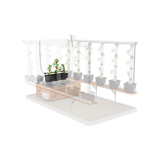
This in-ground aquaponics kit is designed for raising edible fish and growing fruit and vegetables in two buried tanks, over approximately 2 m² of ground space. Water is circulated by a 27 W air pump, or two pumps in the 1,000 L format, with no submerged water pump.
Orders are placed directly on the manufacturer's website, taireau.fr.
Free and without obligation: we get back to you with a tailored offer.
Free when you go through Univers Aquaponie
£150 worth of consumables of your choice from the Univers Aquaponie catalogue
 Customer support 7 days a week by email
 Delivery within 2 to 15 business days
The Taireau buried aquaponic kit is for raising cold-water fish (trout, brook trout, perch) and growing fruit and vegetables in two buried tanks of 500 or 1,000 L, on roughly 2 m² of floor space. Water circulates thanks to the air from a 27 W pump, with no submersible water pump, and the ground limits temperature swings.
This aquaponics kit rests on one design choice: two buried tanks, one for the fish, the other for the crops, leaving only a wooden lid and the grow bed above ground. The water flows from one to the other without a water pump, driven by the air from a pump installed out of the water, and the system raises cold-water fish for your table: trout, brook trout or perch.
The kit comes in two sizes, with two food-grade HDPE tanks of 500 L or 1,000 L each, and it is delivered with all its equipment: the air pump(s), the complete circulation circuit, the clay pebbles in the volume for the size you choose, the lid and an assembly guide with video tutorials. The groundwork is left to you, since this is the self-assembly version. From 2 m² of floor space, it can be installed in a town garden as easily as in the countryside.
Below the surface, soil temperature varies far less than air temperature, and without the daily peaks. By burying the tanks, you give your water this inertia: it warms up less in July and cools down less in January than a pond sitting in the sun. For cold-water fish, this is decisive, because it is the temperature peaks, more than the average, that put them under stress. The whole installation also becomes very discreet in the garden: once the work is finished, all you see is a lid flush with the grass. This lid is made of wood charred using the Japanese yakisugi technique, which carbonises the surface of the wood to make it rot-proof without any chemical treatment, and its mesh-covered window lets you see the fish while keeping leaves, cats and herons away.
Understanding the system before you dig
The Germiponie online course is designed by the same team as this kit, and it explains in videos the balance between fish, bacteria and plants, then how to read water analyses. Followed while you prepare the groundwork, it lets you approach filling the system knowing how to interpret every reading. You can follow it at your own pace, from a phone, and it welcomes complete beginners.
Most systems circulate the water with a submersible pump. Here, a 27 W air pump, installed out of the water, injects bubbles at the base of a column, and the water rises with them: this is the air-lift principle, which moves water and oxygen at the same time. You therefore have no motor under the water, no impeller to clean, and only one wear part that you can reach without getting your hands wet. The 500 L format runs on one pump, the 1,000 L on two, that is 27 W or 54 W continuously, which represents about 0.65 or 1.3 kWh per day. The air-lift moves large volumes at low height: it is ideal for two neighbouring, buried tanks, and much less suitable for a crop that would have to be fed two metres higher up.
Locate underground services before the first dig
Once a buried and wedged tank is in place, it can no longer be moved. So before you dig, find out where your underground services run, water, gas, electricity and drainage, and check that the base of the excavation is stable and sits above the water table. Also consider how much sun the grow tank will get, how far it is from a protected outdoor socket, and the access around the lid, which you will need to open to feed, empty or net the fish.
The thermal inertia of the ground naturally steers the choice of species towards cold-water fish: rainbow trout, brook trout, perch. These are food fish, raised at low density, roughly four times less crowded than in fish farming. The 500 L format produces up to 30 kg of fish and up to 70 kg of vegetables a year, and the 1,000 L format more than 50 kg of fish, figures that are indicative and depend on the species and how the system is run. Trout need well-oxygenated water and tolerate a sustained rise above 18 °C poorly, a constraint that burying the tanks helps you keep within. You introduce the fish in stages after the biofilter has been started up, and you can read the article on trout in aquaponics for their detailed requirements.
The balance of an aquaponic system is set by the feed you give each day. On the 500 L format, a tank stocked with 15 kg of trout fed at 1% of their body weight receives about 150 g of feed per day. Since one square metre of leafy vegetables makes use of 40 to 50 g of feed per day, and one square metre of fruiting vegetables 50 to 80 g, this ration supports about 3 m² of lettuce. Start with the least demanding crops, lettuce, chard and spinach, and add cherry tomatoes, herbs and then courgettes as the fish load increases. The media bed also acts as the biological filter, its porous surface housing the bacteria that convert ammonia into nitrates; this is why it should never be washed completely between crops. The guide to the nitrogen cycle explains these transformations in detail.
You do not run this system in the same way from one season to the next. In summer, your attention goes to oxygen: warming water holds less of it, and the air-lift, which oxygenates continuously, then comes into its own. In winter, the trout stay active in cool water that the ground keeps from freezing at depth, but they eat less: reduce the ration as the temperature drops, because feed the trout leave uneaten decomposes in the tank. In spring, growth resumes and you can increase the stocking load if your readings stay stable. A tunnel or geodesic greenhouse placed over the growing tank extends the plants' season. Finally, the system tolerates up to 15 days of absence, provided a neighbour calls in to check that the air-lift is running.
The media bed supplied is new: before it can receive trout, it must be colonised by nitrifying bacteria, which takes 3 to 5 weeks, longer in cold spring water. Take your samples from the fish tank, where ammonium and then nitrites are read in succession; as long as either of the two is still measurable, the tank is not ready. Once both read zero and nitrates are visible, introduce only a few trout, then increase the stocking in stages. The pH is set between 6.4 and 7.5 and corrected in small steps, as trout tolerate sudden swings poorly. Test these values every other day during this phase, then once a week. An aquaponics test kit covers these measurements, and starter bacteria speed up the establishment of the colony.
The air pump is the only active part you will have to keep an eye on, and it runs dry, so its maintenance comes down to very little. Its diaphragms wear with running hours and lose output, which shows as weaker bubbling in the column; keep a spare diaphragm in hand, since a stopped air-lift interrupts both circulation and oxygenation. Place the pump out of the rain and above the water level, and fit a non-return valve on its outlet so that a power cut does not let water flow back into the pipe. An annual service can be entrusted to the manufacturer, who will then bring the system up to date. With this annual servicing, the installation's lifespan exceeds 10 years.
The version offered here is a kit that you assemble yourself, supplied with a guide and video tutorials. The groundwork takes more effort than the assembly: you need to dig the pit for the two tanks and plan how to bed them in. Decide whether you will do it with a spade or a mini-digger, and bear in mind that a layer of compacted sand under each tank and an even backfill all around prevent the stresses that deform an HDPE wall. Plan for two people on installation day, as an empty tank is awkward to manoeuvre at the edge of an excavation, then half a day for filling and start-up, before introducing anything living. 95% of the equipment is of French origin.
The essentials
Production and durability
Installation
To budget for separately
8 further specifications are available in the detailed view.
In the box
Volumes, pumps, grow medium, yields, origin, and service life: information from the manufacturer T'air-Eau (taireau.fr), recorded on 20/09 and 07/10/2026. Yields are approximate annual figures.
Manufacturer and product safety
Information provided under Regulation (EU) 2023/988 on general product safety.
Request a free quote with no obligation: we get back to you with a tailored offer.
Free when you go through Univers Aquaponie
£150 worth of consumables of your choice from the Univers Aquaponie catalogue
The two kit sizes, compared on what each one offers and requires.
| Volume per tank (L) | Total water volume (L) | Clay pebbles included (L) | Fish production per year | Circulation | Groundworks | Price | 27 W air pumps | Power consumption (W) | |
|---|---|---|---|---|---|---|---|---|---|
| Recommended 500 LYour choice | 500 L | 1000 L | 500 L | Up to 30 kg | Air-lift, no water pump needed | At your expense | $3,269.00 | 1 | 27 W |
| 1000 LYour choice | 1000 L | 2000 L | 1000 L | Over 50 kg | Air-lift, no water pump needed | At your expense | $3,269.00 | 2 | 54 W |
Volumes, pumps, grow medium and yields: information from manufacturer T'air-Eau, checked on 07/10/2026. Yields are indicative annual figures.
Help choosing
Which size for your garden?
Reportage France 3 Rhône-Alpes sur une installation complète
Reportage du Progrès : des truites et des légumes sur un petit espace
Reportage BFM Lyon : des poissons pour cultiver ses plantes
Your estimate
It covers preparing your order and then the transit time quoted by the carrier, counted in working days.
It is not a guaranteed delivery date: public holidays, peak periods, customs or a carrier delay can extend it. The exact amount, in your currency, is worked out in the cart once your address is entered.
The tanks and grow medium represent significant volume and are shipped by haulier. Check that the lorry can get close and that there is a drop-off space near the site.
12 questions
6 key questions, 12 in the detailed view

What happens between the fish tank and the clay pebbles.


The qualities of expanded clay compared with other growing media.
The reading that gives the go-ahead for the first fish.
Stocking density, oxygen and temperature in a home fish tank.
A question about this product or your setup? Our team will answer and advise you.

Interest-free instalment payments
Offered depending on the cart amount, at checkout.

Delivery in 2 to 15 working days
Depending on the products and shipping sites. Estimate by destination in the estimator on this page.

After-sales service 7 days a week by email or chat
Our team answers all your questions.

Shop responsibly
Become part of the change.


