
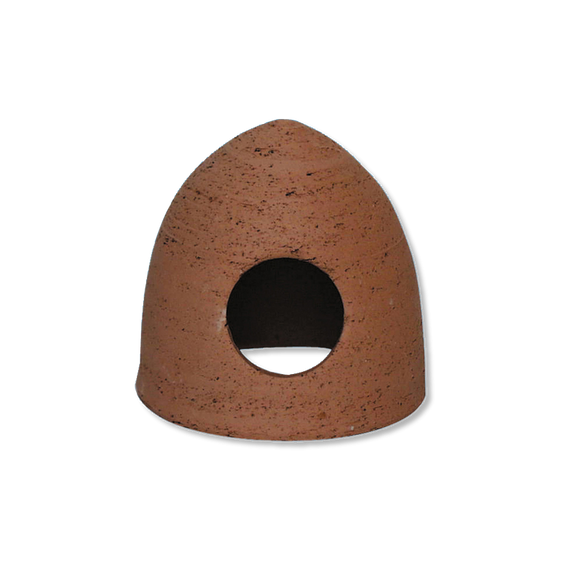
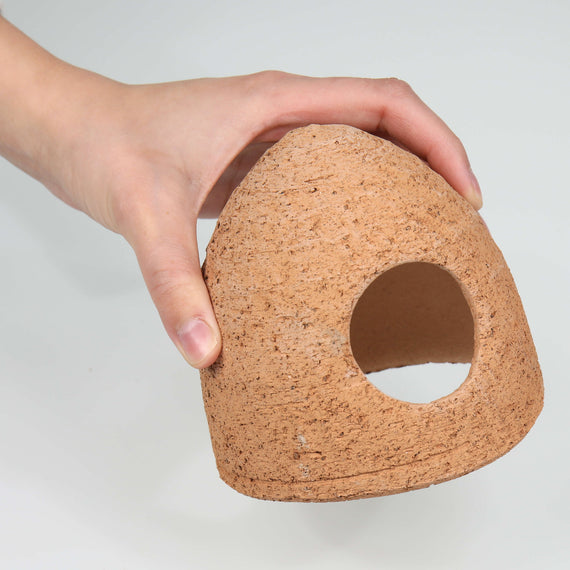
JBL spawning cave in fired clay, 12.5 cm
Regular price
$12.00
Regular price
Sale price
$12.00
Unit price
/
per
This fired clay cave, 12.5 cm high, suits species that lay their eggs on the ceiling of a cavity and guard them.
Outside the breeding season, the cave remains the pair's refuge.
 Customer support 7 days a week by email
 Delivery within 2 to 15 business days
100 % secure payment
The summary
- What you receive: a fired clay cave 12.5 cm high and 11.5 cm in diameter.
- What it allows: spawning for species that breed in an enclosed cavity.
- Which species it suits: bristlenose catfish (Ancistrus) and Pelvicachromis pulcher, among others.
- Where to put it: in a calm, shaded area, with the entrance facing the glass.
- What it does to the water: nothing, fired clay is a neutral material.
- Shipping: terracotta item, wedged securely in its parcel, can be combined with your order.
Fired clay cavity where cave-dwelling species lay and guard their eggs
The JBL fired clay spawning cave, 12.5 cm high and 11.5 cm in diameter, offers species that spawn in enclosed cavities a single-entrance site, where the male guards the eggs stuck to the ceiling. It is particularly suitable for Ancistrus and Pelvicachromis pulcher, and its fired clay is neutral for the water.
Several freshwater species prefer to spawn in an enclosed cavity with a single entrance, where the male guards the threshold while the eggs stay stuck to the ceiling. This terracotta cave, 12.5 cm high and 11.5 cm in diameter, reproduces this shape, and it remains a refuge for the fish that occupies it outside the spawning periods.
🕳️ A cavity with a single entrance
The inlet
The male occupies this single passage and blocks the other fish from entering it.
The lid
The eggs stick to the underside of the arch, out of reach of fish that dig through the substrate.
Darkness
The inside stays in the dim light sought by species that spawn under cover.
These three elements go together: with two entrances, the male can no longer defend the cavity, and light passes through it. Place the cave directly on the substrate, with the entrance facing the front glass, in a shaded area and out of the direct flow of the filter. This way you will see the pair's comings and goings without having to disturb them, and you will not move it again once a fish has adopted it.
🐟 The species that use it
Two groups of fish commonly breed in it. Bristlenose catfish of the genus Ancistrus lay their eggs on the roof of the cavity, then the male stays at the entrance and fans the eggs with his fins until they hatch. Pelvicachromis pulcher, a small West African cichlid, also lays its eggs there, and the pair then guard their fry around the cave. If you keep one of these species, this cave gives an established pair the enclosed spawning site it is looking for.
Sheltering the fry and monitoring the water after spawning
Growing fry need two things: somewhere safe to shelter them, such as the floating breeding trap, and food that suits their size. Water monitoring also needs to be tighter, since the load on the tank increases, and an essential test pack covers ammonium, nitrite, pH and KH from the same water sample.
Outside the breeding season, the cave remains the refuge of the fish that has claimed it, and you will often find it inside during the day, particularly if it is an Ancistrus, which is more active at night. In a community tank, a well-defined shelter also limits chasing, since its occupant defends the entrance of a cavity rather than an open area of the décor, and the other fish keep the rest of the tank to move around in.
🧱 A fired clay piece
Fired clay is a porous ceramic: it does not dissolve and changes neither the pH nor the hardness, which makes it suitable for the soft, slightly acidic waters that most cave-dwelling species prefer, waters that catappa leaves help to achieve. Its rough surface becomes covered within a few weeks with a biofilm that Ancistrus scrape off with their sucker mouths. It remains brittle under impact: if you take it out, handle it gently during cleaning, and place it on the sand rather than on a hard stone.
Technical specifications
The essentials
- Height
- 12.5 cm
- Diameter
- 11.5 cm
Material and use
- Material
- Neutral fired clayIt releases nothing into the water and does not break down.
- Location
- Quiet, shaded areaInlet facing the front, so you can see what happens there.
In the box
- 1 fired clay spawning cave
Height, diameter, material and species mentioned taken on 20/09/2026 from the JBL manufacturer's description, reference 6150100.
Manufacturer and product safety
- Manufacturer
- JBL GmbH & Co. KG
- Postal address
- Dieselstraße 3, 67141 Neuhofen, Allemagne
- Contact
- info@jbl.de
- Website
- www.jbl.de
Information provided under Regulation (EU) 2023/988 on general product safety.
Estimate your
delivery time
Your estimate
Delivery
Estimated time
It covers preparing your order and then the transit time quoted by the carrier, counted in working days.
It is not a guaranteed delivery date: public holidays, peak periods, customs or a carrier delay can extend it. The exact amount, in your currency, is worked out in the cart once your address is entered.
This cave is made of terracotta and travels wedged securely in its parcel. It can be combined with the rest of your order, and the cost is calculated at checkout according to your destination.
Frequently asked questions
6 questions
6 key questions
You may also like



Related articles

Fish
Which fish to choose for aquaponics?
The species that breed in a tank, and under what conditions.
Read the article

Wellbeing
Is aquaponics suited to animal welfare?
An assigned territory lowers aggression across the whole group.
Read the article

Bases
The nitrogen cycle in aquaponics
Spawning raises the organic load, and the test shows it.
Read the article

Water
Understanding and clearing cloudy water
What clouds the water when you move a decoration that is already in place.
Read the article

Assembly
Setting up your aquaponic system
The fish tank, its calm zones and its areas of current.
Read the article
Let us talk about your project
A question about this product or your setup? Our team will answer and advise you.

Interest-free instalment payments
Offered depending on the cart amount, at checkout.

Delivery in 2 to 15 working days
Depending on the products and shipping sites. Estimate by destination in the estimator on this page.

After-sales service 7 days a week by email or chat
Our team answers all your questions.

Shop responsibly
Become part of the change.
